PHOTOS BY ELIZABETH HAY PHOTOGRAPHY
By
Jessie Bengoa, MS
![]()
, Platinum Performance®

Jessie Bengoa, MS,
Platinum Performance®
Jessie Bengoa, MS is the author of recent articles on Equine Kissing Spines, Equine Gastric Ulcer Syndrome and Equine Herpes Virus. In addition to being a lifelong horsewoman, Jessie has over 17 years of experience in the world of food and nutrition with special expertise in equine nutrition.
Industry Titans, Iceland-Born Ásta Dögg Bjarnadóttir-Covert and Husband Will Covert — Owners of the Flying C Ranch on California’s Central Coast — Give Us an Inside Look
When quizzed about the best-known equine breeds, most American riders and horse fans might conjure in their mind’s eye a slide show of distinct images: versatile Quarter Horses dominating a rodeo arena; Thoroughbreds passing the iconic Twin Spires at Churchill Downs at the Kentucky Derby; and Warmbloods scaling imposing jumps or dancing their way through a dressage test. While the more prolific breeds certainly garner the spotlight, there are other niche worlds that center around breeds with their own unique traits, gaits, behavior characteristics and culture. Case in point: the Icelandic horse.
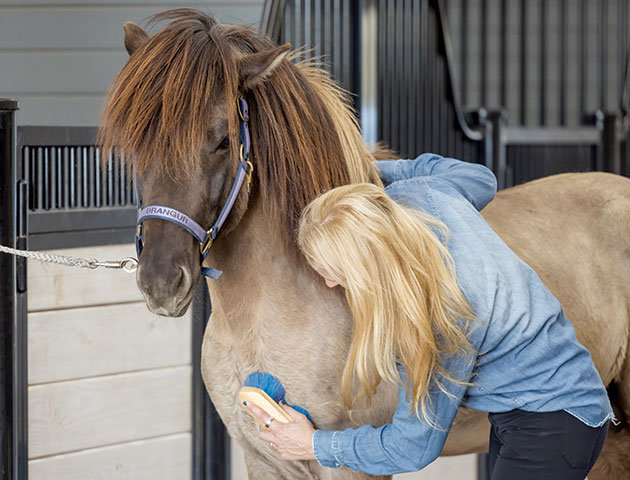
These small-but-rugged creatures are known for their modest size (typically 13-14 hands high and weighing 730 to 840 pounds), robust and voluminously photogenic manes and tails with teddy bear ears and personalities significantly grander than their stature. And there’s that special gait. Icelandic horses are a five-gaited breed thanks to a genetic trait from centuries of selective breeding on their island nation. Inside the virtually unspoiled culture of the Icelandic horse are thousands of breeders, competitors, riders and lovers of a steed that remains deeply tied to tradition and is exceptionally pure.
About the Breed
Icelandic horses are typically 13-14 hands high, weigh about 730-840 pounds, and have robust and voluminous manes and tails.
Icelandic horses are a five-gaited breed thanks to a genetic trait from centuries of selective breeding on their island nation.
Horses living within the confines of Iceland itself remain entirely isolated and free of most major international infectious equine diseases. They are the only breed of horse on the island where imports are banned, and though they are exported around the world, once they leave they can never return.
Brought to the island nation by Vikings in the 9th and 10th centuries aboard long boats, this breed was used for both transportation and farming and has evolved to be sturdy, full of personality and a favorite amongst residents of its home country and abroad.
Deep Roots
Throughout history, this level-headed and trustworthy horse has been a central player in the culture and traditions of Iceland, situated between the Arctic and North Atlantic oceans. Perched on a rift between tectonic plates that have fostered cinematic landscapes both sweeping and dramatic, dotted with active volcanoes, waterfalls and vast verdant terrain offset by lava fields, geothermal lagoons, geysers and black sand beaches. Here, Icelandic horses are an ancient breed, brought to this island nation by Vikings in the ninth and 10th centuries aboard long boats. Used for hundreds of years for both transportation and farming, the breed has evolved over the millennia to be sturdy, full of personality and a favorite amongst residents of its home country and abroad.
Due to the often-harsh winter climates of Iceland — especially in the windy northern area — and sometimes unforgiving landscape, only the strongest survived, giving them a sure-footed nature, a double-thick winter coat and a hearty, easy-keeping resilience. Even today, horses living within the confines of Iceland itself remain entirely isolated and free of most major international infectious equine diseases as well as natural predators. They are the only breed of horse on the island where imports are banned, and though they are exported around the world, once they leave they can never return.
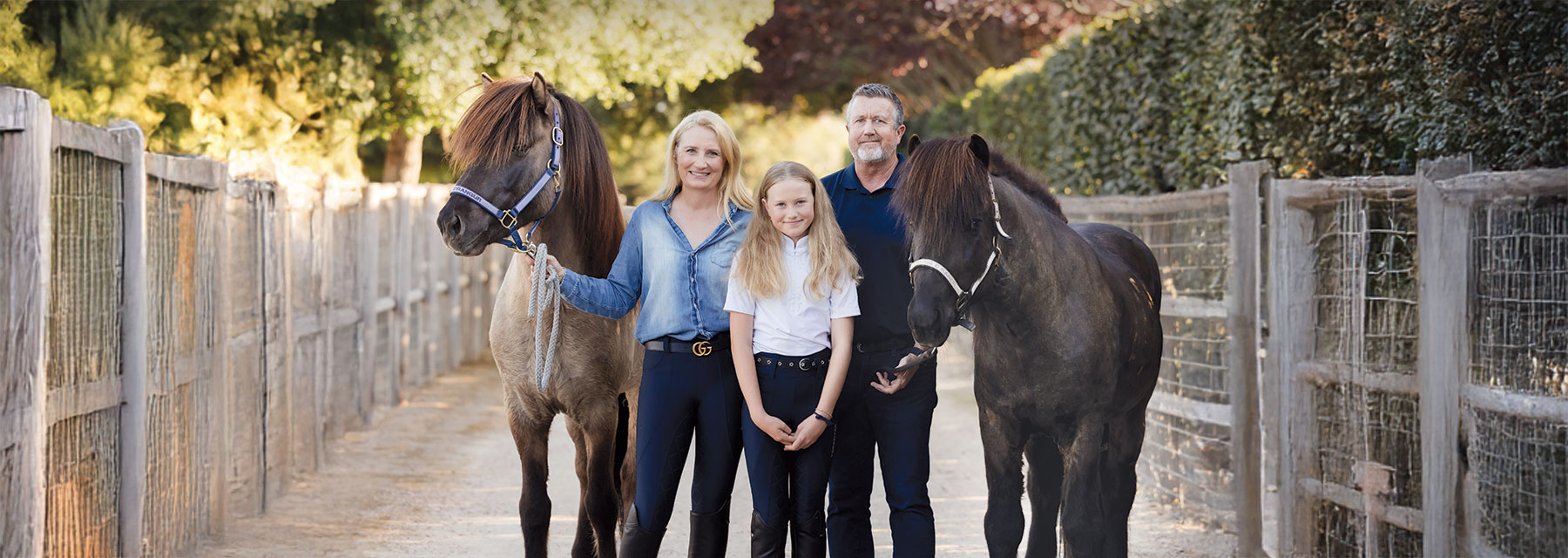
Ásta Dögg Bjarnadóttir-Covert, her husband Will Covert and their daughter Anna Bella are all deeply enveloped by Icelandic horses.
The Making of Champions
To most, Iceland is a mystery: a faraway place with an enigmatic allure, marked by the Northern Lights and a unique culture and cuisine. To Ásta Dögg Bjarnadóttir-Covert, the Land of Fire and Ice is simply, home. She grew up in a family of horse people that raised, rode and showed the horse. Her childhood was spent atop the wild-haired steeds: her blonde hair flowing in unison with her mount’s as they sped across the landscape. “I grew up riding Icelandic horses in what we call a ‘club,’ ” says Asta. “People own their own stables within a community, but we share an oval track and an indoor arena. We’d have seminars, shows and educational events; it was very social.”
Asta’s father, Bjarni, owned a stable within one such community, which afforded the family easy access to pursue their shared passion. “I’d come home from school, ride my bike to the riding club and spend every minute I could there with the horses. My whole family was immersed in it; it was our lifestyle,” she remembers. December through June is peak riding and showing season in Iceland, after which many Icelanders head to their summer homes, often bringing their horses along for turnout and summer riding. Asta and her clan were no different, relishing the summer months riding before heading back to their regular routines.
Fast forward to present day, and Asta’s view has changed significantly. Now stateside, she represents Team USA as a top rider and trainer on the international stage. She and her husband, Will Covert, are the owners of Flying C Ranch, a leading Icelandic horse facility nestled in the Santa Ynez Valley, north of Santa Barbara on California’s charming and fertile Central Coast. Will, a multi-American champion in his own right, was the first U.S. rider to make the finals at the Icelandic World Championships in 1997 aboard Dynur frá Ytra-Skörðugili. Just two years later, he clenched the coveted World Champion title in Tölt 2 (a natural four-beat lateral gait) riding the famed Blær fra Sigluvík.
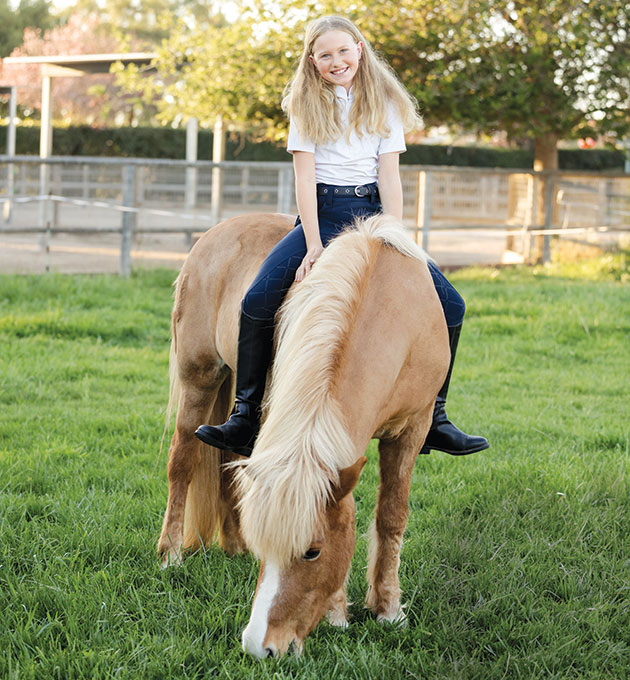
Today, Will is active with Föderation Europäischer Islandpferde Freunde, sitting on its board of directors and serving as its director of sport. FEIF was founded in Germany in 1969 and, today, is known as the International Federation of Icelandic Horse Associations, representing a collective of national Icelandic horse associations from over 20 countries and 80,000 members worldwide. The organization stewards the breed, guiding future plans along with horse welfare and ethics. Will is fluent in both the Icelandic language and the intricacies of Icelandic horses, their breeding, importing and the show structure that keeps worldwide competition thriving for the breed. The couple’s 11-year-old daughter, Anna Bella Covert, is already a nationally ranked and award-winning junior rider. The family’s life is deeply enveloped by Icelandic horses; they import, train, breed and show them, often hosting shows at their facility.
“These horses have good character. They’re really confident horses, and they’re healthy.”
Will Covert, International Federation of Icelandic Horse Association Board Member
Hard Working Easy Keepers
Icelandic horses are certainly sturdy, perhaps thanks to a multi-century adaptation to their native island environment. Vikings are credited with introducing them to Iceland, transporting them across the North Atlantic in open long boats with narrow beams, giving rise to the theory that the horses chosen to make the trip were of exceptional temperament and physical health; traits that have continued through the breed’s evolution. “These horses have good character. They’re really confident horses, and they’re healthy,” explains Will. “Up through WWII, the same horse was often used by families for farm work, transportation to church on Sundays and for competitions between farmers from different areas of Iceland. They’d compete to see who had the flashiest horse and the best gaits.”
It wasn’t until much later, when the post-war Marshall Plan sent tractors and jeeps in the late 1940s that the role of the Icelandic horse transitioned to a more leisure-centric show horse, and today’s unique competitive “sport” shows.
Truly easy keepers, the horses require fewer calories having evolved on a diet of grasses and other forage produced during Iceland’s 75-120 day growing season. Owners are reminded to avoid overfeeding their horses, as obesity and metabolic dysregulation can become problematic.
“Growing up in such a northern climate, the seasons are short and the grasses are not strong,” confirms Asta. “Our hay growing season is less than three months long. We store that hay and feed it for the remainder of the year. These horses are not accustomed to alfalfa or higher calorie options, so we have to be mindful.”
To compensate, the Coverts source their hay from Alberta, Canada, to mimic a diet that the horses would consume in Iceland. “We feed Platinum Performance® DJ all year round, and we make sure to manage their exercise, so they’re staying fit,” says Asta.
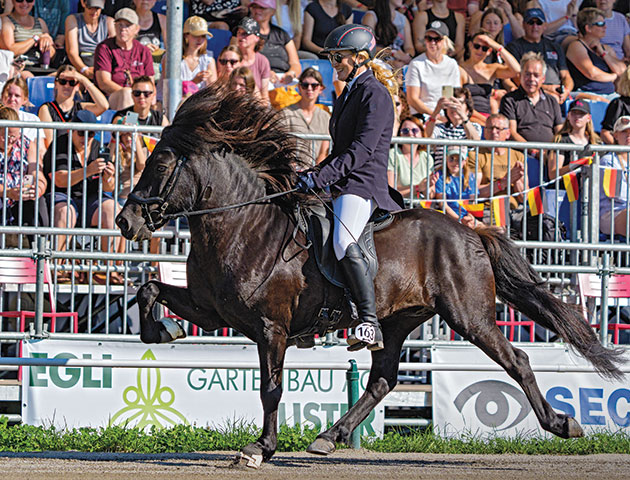
PHOTO BY KRIJN BUIJTELAAR
At the 2025 Icelandic Horse World Championships in Birmenstorf, Switzerland, Asta and her stallion, Gígur frá Ketilsstöðum, earned the highest score of the Team USA riders, made even more impressive by the fact that her mount traveled the farthest of any horse being shown.
The Nuances of Riding and Showing
The Icelandic show world is unique and centered on one breed. On a 250-meter (273.4 yard) oval track, it showcases the breed’s unique gaits — tölt and flying pace — as well as the fundamental movements — walk, trot and canter/gallop. While most Icelandic horses have four gaits, not all are trained in or naturally perform the flying pace (skeið), so competitive classes are divided based on the horse’s ability.
The five-gaited, or F-class, horses are shown at walk, trot, canter, tölt and the two-beat flying pace that can reach speeds up to 30 mph with a comfortable stride that some riders have cheekily shown off by holding a mug of beer to demonstrate how smooth of a ride it is. In contrast, the four-gaited, V-class features the four-beat tölt, described by one trainer with its tick-a-tick-a-tick-a-tick rhythm, where one or two legs are always on the ground allowing for a comfortable ride at various speeds.
Modern sport competitions began in Europe in the 1960s, using Gæðingakeppni, the traditional format historically used in Iceland. “ ‘Gæðinga’ in Icelandic means ‘the ideal horse,’ ” explains Will. “It’s a little bit more casual and also faster, with the goal being to show the spirit and willingness of the horse. Today’s international competition blends two influences: The traditional Icelandic Gæðingakeppni influence together with the German sport influence,” says Will.
Tack has evolved to meet the needs of the show environment as well. Originally, Icelandic horses were ridden in a shanked curb bit: a single, broken snaffle bit with shanks and a curb chain. “That’s all they were ridden with until the German influence was introduced, then we started using snaffle bits and dropped nose bands,” says Asta. Additionally, the horses wear ballenboots designed to protect the horse’s heel, somewhat resembling more traditional bell boots but instead fasten across the front of the hoof with a simple strap. “They’re exclusively made of rubber because in Iceland, you can be riding in any type of weather, so we don’t want leather or other materials that soak up moisture and become heavier. We have very strict rules as to how much weight we can have on the front feet of the horses when showing, so these boots are light and there to protect them from overreaching,” she details.
In fact, these white boots (the color chosen to attract the eye), come in various weights, all lower than the maximum allotment of 250 grams (nearly 9 ounces). Saddles are almost exclusively imported from Europe, and while they draw influence from dressage, they’re unique to Icelandic horses to accommodate their much shorter backs.
As the Icelandic show world evolved, FEIF became its governing body. U.S. riders are officially ranked in four divisions: youth, novice, intermediate and open. Competitions have five judges who rank horses and riders with numerical scores from zero to 10. World ranking is based on the scoring, with the international system held constant across all participating countries. This show world culminates with the Icelandic Horse World Championships, held every two years at a European location, with the 2025 event held in Birmenstorf, Switzerland.
“There, each country is able to send seven adult riders and five youth riders (age 16-21),” explains Will. “The riders compete in two divisions: either youth or adult.” Team USA had four leading riders: Asta; Caeli Cavanagh, head trainer and instructor at Álfadans Equestrian Arts in Newberg, Oregon; Alexandra Dannenmann, the Florida- and Kentucky-based, 2017 FEIF Trainer and Instructor of the Year; and Jennifer Melville, a certified equine osteopath ranked as one of the 10 best T2 (loose rein tölt) riders at the 2019 world championships. Accompanying them was team leader Jana Meyer, owner of Lunar Hill Icelandics, a teaching and training program in Bridgewater, Vermont, and team trainer Olil Amble.
Asta and her stallion, Gígur frá Ketilsstöðum, earned the highest score of the Team USA riders, made even more impressive by the fact that her mount traveled the farthest of any horse being shown. “I competed a lot as a child,” says Asta, “but then to go to the World Championships where 6,000-10,000 people are there watching and cheering — it’s intense, but it’s so fun. You’re seeing friends. You’re making new friends, and everyone is there for the Icelandic horse. I love it.”
Ásta Dögg Bjarnadóttir-Covert Receives Lifetime Achievement Award
The U.S. Icelandic Horse Congress has announced that Ásta Dögg Bjarnadóttir-Covert has achieved the following accolades, becoming the only rider in the nation’s history to receive Diamond and Platinum Level awards.
- Diamond Level in Four Gait & Tölt (six scores of 7.5 or higher)
- Platinum Level in Five Gait (six scores of 6.5 or higher)
- Gold Level in Loose Rein Tölt (six scores of 6.5 or higher)
Stewarding the Breed
Icelandic horses continue to have pure blood lines, high fertility rates and the hardy genetics that have contributed to their resiliency, health and long lives since their arrival in Iceland over 1,000 years ago. Bred by both live cover and artificial insemination, Icelandic foals are born primarily in the pasture, often unassisted, with mares rarely stalled in preparation for foaling. “In Iceland, we still keep things very close to nature,” explains Asta, who acts as the registrar for WorldFengur, the international database for the registration of purebred Icelandic horses.
“Icelandic horses born in the U.S. require DNA verification through the University of California, Davis, for both the sire and dam to ensure the parentage is accurate,” she continues. “Owners are also required to file stallion reports to make sure the breed is pure.” In Iceland, however, significantly less reporting is required since these horses are the singular breed on an island that prohibits horse imports.
Perhaps an additional boost to their longevity comes from a conservative training schedule. “We start stallions and mares the fall before they turn 4,” explains Asta. “They’re allowed to be shown in breeding assessments at 4 years old where they’re ridden on a straight track only, not in sport competition.” Geldings, in contrast, are sometimes started a bit later at age 5 to 6. “It’s very common to see Icelandic horses being ridden and actively shown well into their 20s,” adds Will. “If owners watch their (animal’s) weight and fitness, they can have a long life and showing career.” This impressive career span is also thanks to strict rules limiting the number of rides each horse can have in competition.
A Breed for Everyone
Spend any time around Icelandic horses, and it’s easy to realize their allure. Their personalities are playful and engaging, and while they’re determined to please, they’re all business on the track. “I’m very biased coming from Iceland,” laughs Asta. “But I just love the way they grow up, so minimally handled and wild until they’re trained.” In Iceland, it’s a closed environment; horses are allowed to be horses. For Asta, Will and Bella Covert, the Icelandic horse is the center of their personal and professional universe. The family is deeply tied to Asta’s homeland and entirely committed to these horses.
“We just want to give something back to the sport and the breed and to continue to grow it here in the U.S.,” says Will. “Icelandic horses are so versatile, and they can be very spirited.” It’s that magnetic nature and a long history of working with these animals that keeps the Covert family focused on what’s next in the industry and in international competition, with their focus centered on the horses they love.

Subscribe to the Platinum Podcast
Icelandic Horses
Asta and Will Covert walk us through the history and characteristics of this beloved breed, as well as the nuances of the U.S. and international Icelandic show circuit.
Listen NowRequest Platinum Magazine
Read inspiring stories of success, companionship and collaboration
At Platinum Performance, we love to showcase the success of our clients, their horses and the veterinarians that care for them. All issues of Platinum Magazine are complimentary.