COURTESY PHOTOS
By
Jessie Bengoa, MS
![]()
, Platinum Performance®

Jessie Bengoa, MS,
Platinum Performance®
Jessie Bengoa, MS is the author of recent articles on Equine Kissing Spines, Equine Gastric Ulcer Syndrome and Equine Herpes Virus. In addition to being a lifelong horsewoman, Jessie has over 17 years of experience in the world of food and nutrition with special expertise in equine nutrition.
In the Immediate Aftermath of September 11, 2001, a Team of 12 Warfighters led a Makeshift Horseback Army, Tackling Seemingly Insurmountable Odds in the Rugged Terrain of Northern Afghanistan
Once. Only one time in the past 80 years has the United States experienced a large-scale attack on the homeland: a left-field assault on a sun-drenched September morning in 2001. Amongst the glistening skyscrapers of Manhattan’s Financial District, the ordinary abruptly turned chaotic. Americans watched in pained disbelief as commercial jetliners careened into iconic twin pillars of the New York City skyline. Once, then twice, they struck violently, followed by a direct hit on the Pentagon and a fourth downed passenger plane in rural Pennsylvania. The toll was staggering: 2,977 fellow Americans were lost in the unprovoked attacks.
Ask almost anyone where they were in those moments, and they will tell you with precision. The memories remain vivid even 25 years later — seared into the nation’s conscience. Arguably just as strong are the vivid memories of Sept. 12 and the ensuing months and years when Americans bled red, white and blue and stood shoulder-to-shoulder with pride, shared patriotism and a yearning for justice. The nation was sucker punched — bent but not broken — and poised for the fight ahead.
The Immediate Aftermath
While most Americans watched the battle unfold on-screen from the security of home, others were tasked with bringing American justice to the enemy and liberating the remote mountainous country of Afghanistan from the clutches of Taliban and al-Qaida control. Immediately following the attacks of Sept. 11, warfighters were called into action, battlefield strategy developed in real-time and America embarked on a multi-pronged offensive to defeat the grip of a prolific global terror network.
For Mark Nutsch, then a U.S. Army Special Forces Captain, his path suddenly diverged, sending him on a mission that would change the trajectory of both his own life and the global war on terror. “Prior to 9/11, I was a Special Forces Detachment Commander, as part of the 5th Special Forces Group,” he says. “I had led the 595 team (Operational Detachment Alpha 595, or ODA 595) for two years on half a dozen training deployments to the Middle East and Central Asian states, the former Soviet republics. My two years was up on Sept. 10, 2001, and I was moved to a staff operations position.” It was a typical career progression that often sees officers transition from the field to desk jobs.
“Like everyone else, I watched 9/11 unfold from home with two young sons and a wife carrying a high-risk pregnancy with our first daughter,” he adds. Three days later, Nutsch and his wife, Amy, were roaming the aisles of a Babies R Us store in Nashville, Tennessee, when his cell phone rang: “It was my team sergeant. He was brief; orders were to return to the unit and bring all my gear.” A career Ranger and Special Forces officer, Nutsch knew he was being deployed. “I’m going to war with my brothers,” he remembers thinking. “I was back in the team room after 96 excruciating hours in a staff position,” he says, smiling at the mercifully brief time spent at a desk.
That afternoon, the 32-year-old and his 11 teammates of ODA 595 were informed that they would be the first team of U.S. Army Special Forces — known as Green Berets — to deploy to Afghanistan as part of Task Force Dagger. “There were a lot of unknowns,” he remembers. “It had been three days since Sept. 11; America was not ready to fight in Afghanistan. The larger strategy and our initial plan was being put together on the flight over there.” The team commenced their own rapid-fire reading mission, poring over whatever intelligence they could gather on Afghanistan — including National Geographic and tourist maps — to better understand the people, landscape, the geopolitical climate and the enemy forces they would be facing. These included the Taliban and al-Qaida, armed with Soviet armor and artillery left behind in 1989 when the Soviets left Afghanistan.
“We landed at a secret base in Uzbekistan, which is adjacent to Afghanistan to the north,” Nutsch tells of the team’s initial hours in the Middle East. “Our team was the seventh aircraft to land back in the new Central Asian ally, post-Sept. 11.” They were the tip of the spear: A dozen men that would be tasked with one of the most monumental missions of the early conflict.
“We dispersed these four cells with their partner force (three Green Berets were each paired with an Afghan commander and 300-750 militia horsemen) into risky situations, with each of the groups going into different districts or counties and onto the battlefield. We were spread out over a lot of terrain and miles.”
— Major Mark Nutsch, Commander, ODA 595
U.S. Army Special Forces
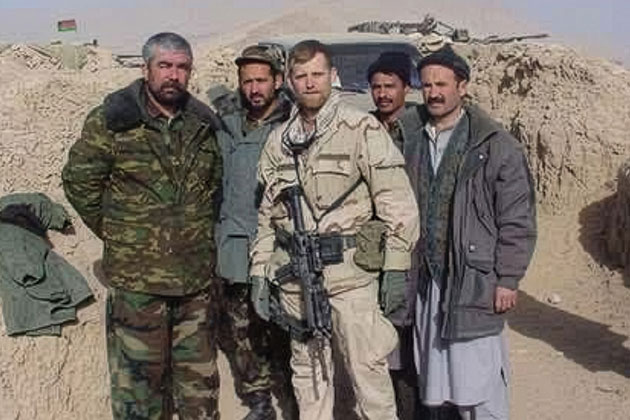
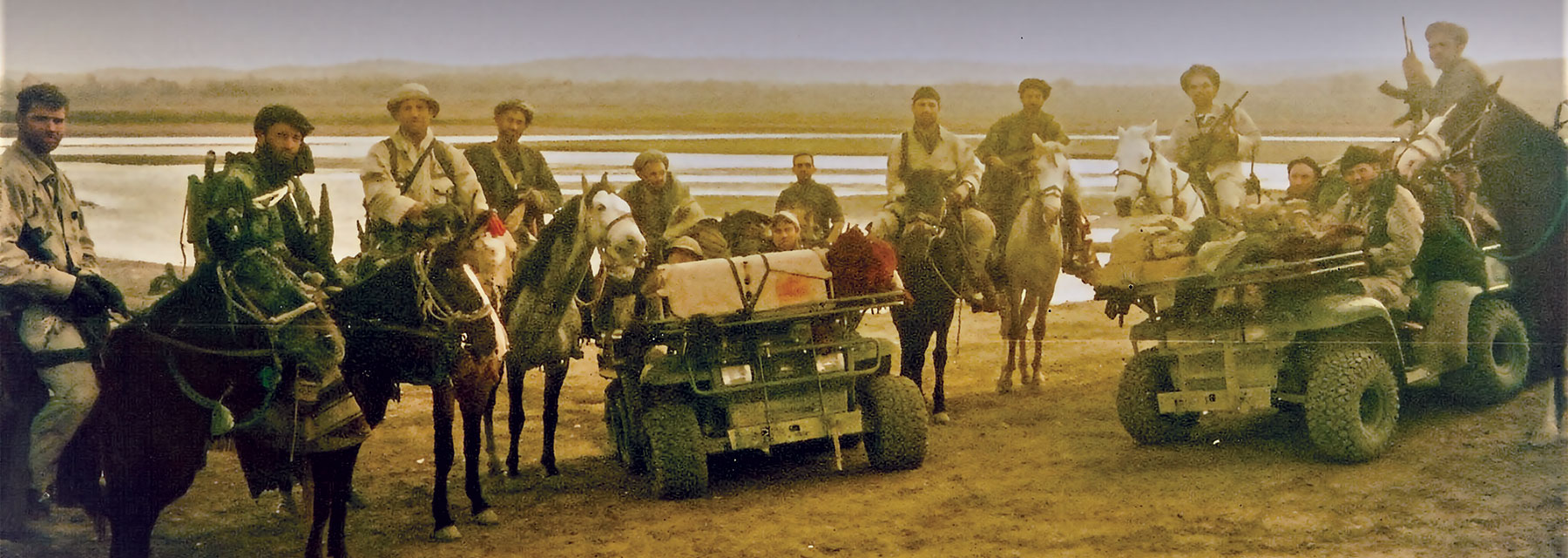
Operational Detachment Alpha 595, led by then-Captain Mark Nutsch were the first team of U.S. Army Special Forces to deploy to Afghanistan as part of Task Force Dagger after 9/11. Being on horseback allowed the team to be nimble, riding through terrain impassable to vehicles, including riding through brutal weather conditions and traversing snowy mountain passes.
High-Risk Insertion
Under cover of darkness on Oct. 19, 2001, Nutsch and his men helicoptered into Northern Afghanistan, among the first teams to infiltrate the country post-9/11. It was a harrowing insertion involving specialized twin-rotor, MH-47 helicopters flown by Army Special Operations aviators and supported by Air Force Special Operations aircrews aboard a MC-130 tanker, an aircraft capable of refueling fixed-wing and rotary-wing aircraft like the workhorse MH-47. The behemoth plane and mixed aircraft formation performed low-level aerial refueling early in the nearly 4 1/2-hour flight. The team made it across the border and into Afghanistan undetected, only to encounter a surprise sandstorm before reaching their landing zone. “Welcome to Afghanistan,” Nutsch laughs.
Due to the storm and flight conditions, their escort MH-60 armed gunships had to turn around, leaving the MH-47 crew and ODA 595 flying alone for over 2 hours through the country’s rugged northern mountainscape. The terrain forced the MH-47 pilots to ascend over 12,000 feet crossing the Hindu Kush Range in Northcentral Afghanistan, causing the team in the rear of the helicopter to lose consciousness until the chopper descended to a lower elevation. Fortunately, Green Berets receive hypoxia training in hypobaric (altitude) chambers. At 2 a.m., the craft touched down on target about 80 miles south of Mazar-e-Sharif where they linked up with their Central Intelligence Agency (CIA) team.
As daylight broke, the CIA operatives introduced the ODA 595 team to General Abdul Rashid Dostum, a former Afghan Army chief of staff (prior to the Taliban’s rise to power in the late 1990s). With an al-Qaida price on his head, Dostum was the primary commander of the Uzbek militia, one of three rival ethnic factions fighting the Taliban-controlled Afghanistan government. Dostum and 50 fighters galloped up on horseback to meet the combined American team.
While the U.S. military had identified the Uzbek militia as potential allies in the fight, Nutsch and his team hadn’t been informed until a few days before the flight into Afghanistan about how they would be getting around on the ground. It became another mission challenge when he was told “be prepared to use indigenous animals for transportation,” since horses were the militia’s primary means of maneuvering the rough mountainous terrain of the region. That shared horse culture would further help unite them.
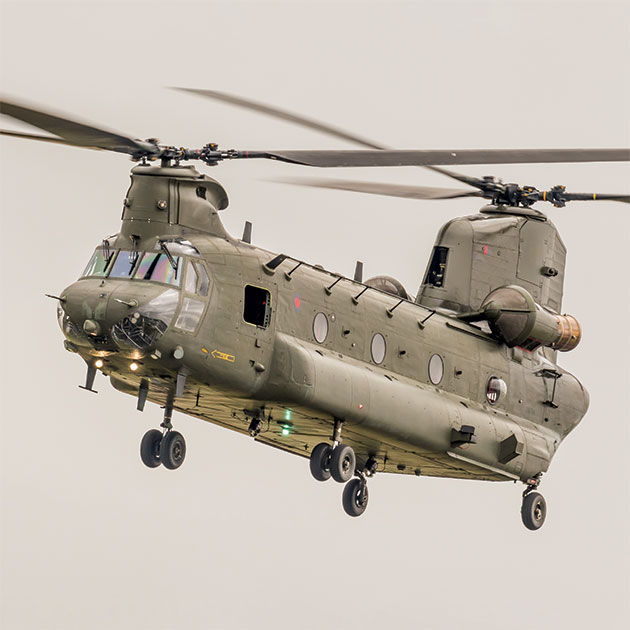
October 19, 2001
Then-Captain Mark Nutsch and his men — Operational Detachment Alpha 595 — helicoptered into Northern Afghanistan via twin-rotor, MH-47 helicopters flown by Army Special Operations aviators, supported by Air Force Special Operations aircrews aboard a MC-130 tanker and escorted by MH-60 armed gunships.
The team made it across the border and into Afghanistan undetected. Due to a sandstorm and flight conditions, their escort had to turn around, leaving the MH-47 crew and ODA 595 flying alone for over 2 hours through the country’s rugged northern mountainscape. The terrain forced the pilots to ascend over 12,000 feet crossing the Hindu Kush Range.
At 2 a.m., the craft touched down about 80 miles south of Mazar-e-Sharif where they linked up with their Central Intelligence Agency team.
As daylight broke, the CIA operatives introduced the ODA 595 team to General Abdul Rashid Dostum, a former Afghan Army chief of staff (prior to the Taliban’s rise to power). With an al-Qaida price on his head, Dostum was the primary commander of the Uzbek militia, one of three rival ethnic factions fighting the Taliban-controlled Afghanistan government.
Unconventional Warfare
The horseback component of the mission went on to become an entirely unexpected defining element, but even for Nutsch, a seasoned cowboy, this was a new ballgame. He was accustomed to the beefy Quarter Horses he’d ridden back home, but in Afghanistan, the horses were smaller and slighter, standing some 13-15 hands with a thin frame and breeds ranging from Yargha (with Mongolian and Arabian bloodlines) to Waziri (a cross between Afghan horses and Arabians). The wiry mounts reminded him of American Mustangs. Culturally, the men exclusively rode stallions, which added a further degree of difficulty.
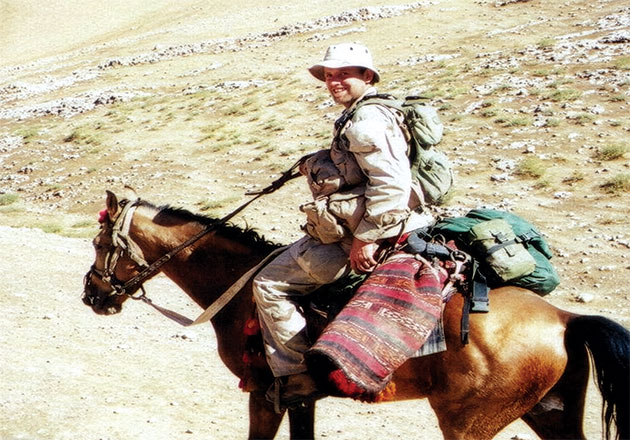
“These guys had some of the best (military) training in the world, but none of it included riding horses,” says then-Captain Mark Nutsch of Operational Detachment Alpha 595. “We were figuring things out in real-time: What gear we absolutely needed to keep on our bodies for contingencies; what we could put on the horses; how to carry a rifle on horseback. My guys rose to the challenge and learned quickly.”
“I knew what happens when you get a bunch of stallions around each other, but my guys didn’t,” Nutsch says with a sly smile, remembering the chaos that ensued when his teammates attempted to ride scrappy and temperamental stallions. “These guys had some of the best (military) training in the world, but none of it included riding horses. We were figuring things out in real-time: What gear we absolutely needed to keep on our bodies for contingencies; what we could put on the horses; how to carry a rifle on horseback. My guys rose to the challenge and learned quickly, although I wish I had the frosty morning buck-out shows on camera; it was wild.”
With some rudimentary riding practice, the Americans headed out on patrols immediately, and only a few days in-country the unit began to split into cells of three Green Berets, each paired with an Afghan commander and 300-750 militia horsemen. “We dispersed these four cells with their partner force into risky situations, with each of the groups going into different districts or counties and onto the battlefield. We were spread out over a lot of terrain and miles,” says Nutsch of their strategy.
The teams carried sophisticated satellite capable radios and relayed coordinates to overhead or en route aircraft to drop bombs on identified enemy positions. Meanwhile, he and his rotating communications sergeants rode between the different units with General Dostum and the resistance leadership; some rides lasted 7–24 hours.
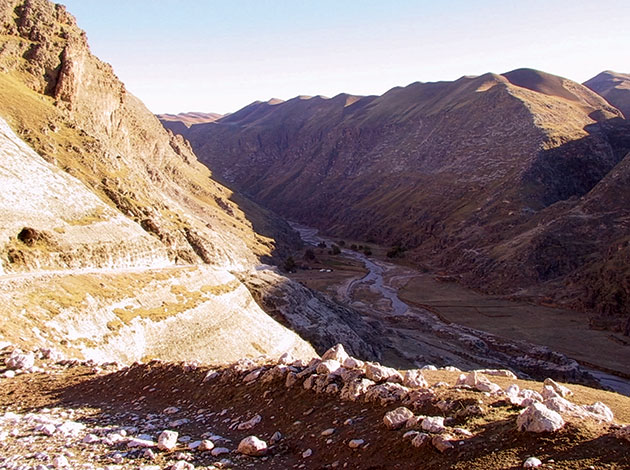
The first cell — of the four dispatched to different regions — made it the farthest into enemy territory, spending two full weeks on their own, on horseback starting with just 30 Afghan riders providing security. “They had succeeded in flanking the Taliban, locating and destroying crucial logistical fuel points. These guys are my heroes,” says ODA 595 commander Mark Nutsch with admiration. “The Taliban and al-Qaida had armored tanks and vehicles along with more modern, mechanized and motorized equipment. Our entire force, meanwhile, is on horseback. The heaviest weapon we had is a machine gun or a rocket grenade launcher.”
The first cell made it the farthest into enemy territory, spending two full weeks on their own, on horseback starting with just 30 Afghan riders providing security. “They had succeeded in flanking the Taliban, locating and destroying crucial logistical fuel points (needed by the Taliban T-72 and T-55 Soviet tanks, BMP-1 infantry fighting vehicles and transport trucks made by ZiL, a former Russian heavy equipment manufacturer). These guys are my heroes,” says Nutsch with admiration. “The Taliban and al-Qaida had armored tanks and vehicles along with more modern, mechanized and motorized equipment. Our entire force, meanwhile, is on horseback. The heaviest weapon we had is a machine gun or a rocket grenade launcher.”
The teams’ horses allowed them to be nimble, riding through terrain impassable to vehicles. The teams rode through brutal weather conditions, traversing snowy mountain passes — short on gear but long on grit. “We slept outdoors, burned immense calories and each lost 20-25 pounds of body weight in the first 22 days,” recalls Nutsch. “We were running on 2-4 hours of sleep a night. We ate one of our military rations a day, giving the other two to our local allies. Those guys were hungry too.”
When able, air drops would arrive with additional equipment, lethal and non-lethal aid, including medical and humanitarian supplies, and occasionally horse feed. Indicative of the U.S. military’s ingenuity, German, Turkish and Uzbek-produced equine feed was sourced, then flown 8-10 hours on an Air Force Special Operations MC-130 and airdropped at night in the mountains where the Special Forces team needed it.
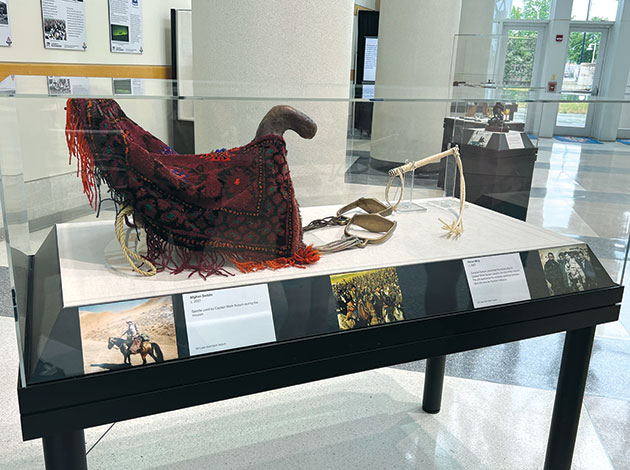
“We were riding Afghan saddles for the first 22 days,” remembers Major Mark Nutsch, ODA 595 Commander. These were constructed of a simple wood frame with some modest leather strapping holding things together and with a piece of carpeting as the saddle seat. “They had a saddle horn and a cantle on the back to hold you in, and your feet slid into heavy fixed length brass stirrups,” Nutsch explains of the wildly uncomfortable saddles that pained both horse and rider.
“The Afghans had very little clothing; literally the clothes on their backs,” he says. “And here we were in the latest American cold weather gear. We were requesting cold weather bundles for them that included more modern gear but also trusty Army wool blankets.” The blankets were meant for the riders but were instead used as horse blankets to keep their mounts warm in the snow. Meanwhile, the Americans struggled to keep warm enough while still blending in with overgarment clothing indicative of the Northern Alliance militia. Body armor was left behind in Uzbekistan, to meet maximum gross weight load restrictions for the MH-47 and to better blend in and lighten the horses’ loads. “We needed to dress more like our allies,” explains Nutsch. “With an American ballistic helmet and body armor, we would look like storm troopers. We could not have that.”
Tack was another challenge. “We were riding Afghan saddles for the first 22 days,” remembers Nutsch. These were constructed of a simple wood frame with some modest leather strapping holding things together and with a piece of carpeting as the saddle seat. “They had a saddle horn and a cantle on the back to hold you in, and your feet slid into heavy fixed length brass stirrups,” Nutsch explains of the wildly uncomfortable saddles that pained both horse and rider. Under the strain of use and with the American’s larger frame (bigger and heavier than Afghans), tack started to break down and leather cinches snapped in high stakes moments. Nylon parachute bundle webbing and parachute cord was used for temporary repairs. ODA 595 members desperately needed tack that would work for them not against them, but resourcefulness prevailed. Nutsch made daily requests for lightweight McClellan and Australian stock saddles to be air dropped into the various teams’ locations; a request that went unanswered until the mission was nearly over.
“When we arrived, there were three rival ethnic factions (Tajiks, Hazaras and Uzbeks). We eventually succeeded in bringing their leaders together, uniting the three groups and further coordinating their actions in a common fight against the Taliban and al-Qaida. They agreed to rise up and fight across the five northern provinces of Afghanistan.”
— Major Mark Nutsch, Commander, ODA 595
On the heels of that unification, the band of Afghan horseback militiamen surged from 300 to some 3,000 strong, guided by Nutsch’s 12-man team of Green Berets and their CIA counterparts
Success on the Battlefield
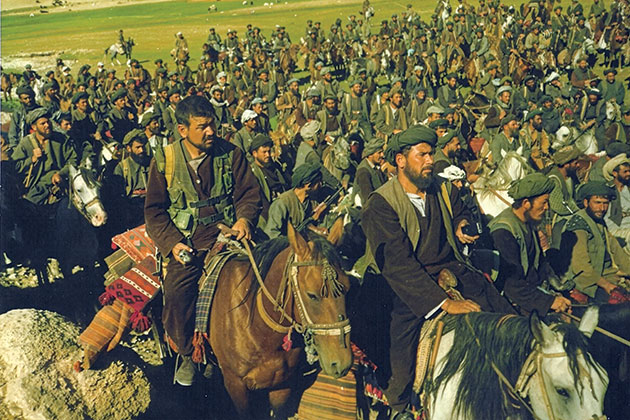
Coupled with the physical and strategic challenges of mounting a calvary opposition, the cultural climate on the ground in Afghanistan in those early days of the war was anything but simple. “When we arrived, there were three rival ethnic factions,” explains Nutsch of the Tajiks, Hazaras and Uzbeks. “We eventually succeeded in bringing their leaders together, uniting the three groups and further coordinating their actions in a common fight against the Taliban and al-Qaida. They agreed to rise up and fight across the five northern provinces of Afghanistan.” On the heels of that unification, the band of Afghan horseback militiamen surged from 300 to some 3,000 strong, guided by Nutsch’s 12-man team of Green Berets and their CIA counterparts.
“These Afghan leaders put out the call and groups of horsemen would come riding into the base camp in groups of 10-20 every single day to join the fight. They were fathers and sons, brothers, uncles and some were just teenagers. They showed up with the clothes on their backs, a worn-out rifle, and a horse; that was it,” marvels Nutsch.
Despite the challenges that horseback warfare brought in the 21st century, it was the horses that facilitated the rapid and astounding success the team and their allies achieved. “Could we have done it without the horses?” Nutsch asks rhetorically. “Maybe. Maybe not. They allowed us to move shoulder-to-shoulder with the militia and gain access we would not have had without them.”
While the team and their mounted Afghan army made rapid-fire progress, there were many close calls and casualties. “It’s a miracle our team survived,” says Nutsch, a solemn expression on his face. “One of the three-man cells was nearly overrun. Our air support was out of bombs, and a pair of U.S. Navy F14s circled back to assist. They were low-level strafing the enemy with cannon fire, doing everything they could to prevent my guys from being overtaken. Our CIA teammates were there the whole time with us. On day ten in-country, two U.S. Air Force Special Operations Combat Controllers arrived. On Nov. 3, two additional Operational Detachment teams — ODA 534 and ODC 53 — arrived to help with the growing militia forces. We had a centralized plan with decentralized execution. We had young sergeants from Special Forces doing incredible things, leading hundreds of fighters in combat for months. Everything and everyone there was trying to kill us, from the terrain to Afghan stallions that would kick, bite and buck, to the cold weather, to the enemy and land mines.”
In the end, and after 22 days on horseback, the team had played a central role in liberating the city of Mazar-e-Sharif by Nov. 10, 2001, along with six Northern Afghan provinces, marking a major turning point in the Afghan War. Over the next week Taliban strongholds crumbled after coalition and Northern Alliance offensives on Taloqan and Bamiyan (Nov. 11), Herat (Nov. 12), Kabul (Nov. 13), and Jalalabad (Nov. 14). The same day Jalalabad was taken, the U.N. Security Council passed Resolution 1378, calling for a “central role” for the United Nations in establishing a transitional administration and inviting member states to send peacekeeping forces to promote stability and aid delivery.
America first learned of the “Horse Soldiers” on Nov. 16, 2001, during the Secretary of Defense’s press briefing when Donald Rumsfeld revealed a photograph of them on horseback. Their full story gained wider public attention through Doug Stanton’s 2009 book “Horse Soldiers: The Extraordinary Story of a Band of U.S. Soldiers Who Rode to Victory in Afghanistan,” followed by the 2017 documentary, “Legion of Brothers” and the 2018 film “12 Strong.”
The mission is still considered to be the catalyst for the initial collapse of the Taliban regime and one of the most successful unconventional warfare missions in modern history. “We fought a battle or skirmish nearly every day: some of them large-scale and others smaller,” recalls Nutsch. “We were outnumbered and up against over 5,000 extremist fighters. We fought their tanks, artillery and heavier equipment, all on horseback.”
With ingenuity, mental toughness and a determination to endure the grueling physical challenge, backed by the might of U.S. Air Force, Naval, Marine Corp and allied aircraft in the skies above them, the team prevailed. “We weren’t in it alone,” Nutsch says, ensuring credit is given where it is due. “We probably still hold a record for over 300 airstrikes.” And although the team of 12 barely made it out alive, there were certainly casualties. “We lost some horses through it all, and our allies had hundreds killed and many more injured,” says Nutsch staring off. It is still painful and a stark reminder of the price paid in the pursuit of freedom.
Toward the end of the mission, on Nov. 25, 2001, the team suffered a heavy blow with the loss of their close counterpart, Johnny Michael “Mike” Spann, a CIA paramilitary officer and former U.S. Marine Corps Captain. The 32-year-old was killed in action — the first American killed in the post 9/11 wars — along with hundreds of militants during an al-Qaida prisoner uprising at Qala-i-Jangi, a 19th-century mud-brick fortress near Mazar-e-Sharif.
America’s Response Monument
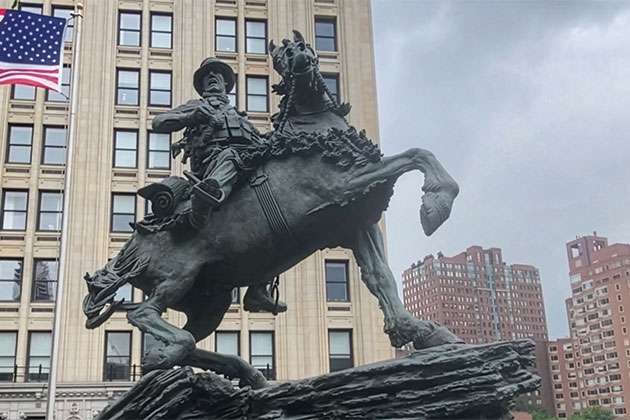
America’s Response Monument (unofficially known as the Horse Soldier Monument) can be found in New York City’s Liberty Park, overlooking the National September 11 Memorial and Museum. The 16-foot tall bronze sculpture honors members of Operational Detachment Alpha 595 and their Afghan allies, led by then-Captain Mark Nutsch as part of Task Force Dagger.
Riding On
After shipping home, Nutsch and his men went on to return to service in various capacities around the globe, but the horseback mission in Afghanistan remains etched into their souls. “I get asked about 9/11 a lot. Those stories from 9/11 deserve our attention. I encourage every American to read about those stories of heroism (on the streets, in those buildings and on the four jetliners hijacked by al-Qaida extremists). Those were American citizens on aircrafts that were used as weapons against their own countrymen, and they had to make horrific life or death choices. Through all the chaos, they chose to be heroes.” Nutsch most prefers to talk about 9/12 when Americans came together, strangers helping strangers and agencies and departments worked together. “We were all Americans united in a common cause,” he remembers.
For ODA 595, each member knew what he was signing up for and that, likely, none would make it home alive. “We were going to be some of the first Americans to set foot over there, and we were honored to spearhead America’s response to the 9/11 attacks,” says Nutsch proudly. “Against all odds, we did make it back. We pushed each other, and we pushed ourselves to the limits of endurance, all while on horseback. We were tested in every way, physically, mentally and emotionally.” The mission was monumental, a pivotal turning point in America’s war against the extremism that had hit out of nowhere at home.
“I’m proud of our local allies, and I’m very proud of ODA 595 and the broader 5th Special Forces Group and the inter-agency men and women of the various special operations components which made up Task Force Dagger,” says Nutsch. “Those guys individually are my heroes. Every one of those team members performed exemplary in combat. They should have all received a Medal of Honor, in my opinion, with the things I witnessed them do.”
Since the team of 12 Green Berets returned stateside, the accolades have amassed. Nutsch left service as a Major after 24 years and saw his character portrayed in “12 Strong” by famed actor Chris Hemsworth. In 2016, a few teammates, including Nutsch, came together to found American Freedom Distillery, featuring their double gold award-winning premium Horse Soldier Bourbon. Now a growing national brand, this July 4th on the 250th Anniversary of America, they will proudly hold the grand opening of their own distillery in Somerset, Kentucky. To further mark the epic occasion, they are hosting a Professional Bull Riders (PBR) Bull Riding – The American Freedom Invitational held on the Horse Soldier Farms property July 3 and 4.
Nutsch and teammate Bob Pennington, with bestselling author Jim DeFelice (“American Sniper”), wrote “Swords of Lightning: Green Beret Horse Soldiers and America’s Response to 9/11,” which was published in 2022 as a first-person account of how their small band used horses and laser-guided bombs to overthrow the Taliban and al-Qaida. Moreover, he was honored by the city of Washington, Kansas, near where he and his wife grew up, with the Mark Nutsch, Horse Soldier Team and 9/11 Monument in a Nov. 19, 2022, dedication, though he admitted in his speech that day to fighting the planned monument in its beginning phases, not wanting to be singled out, as he believed his team were just doing their jobs as soldiers.
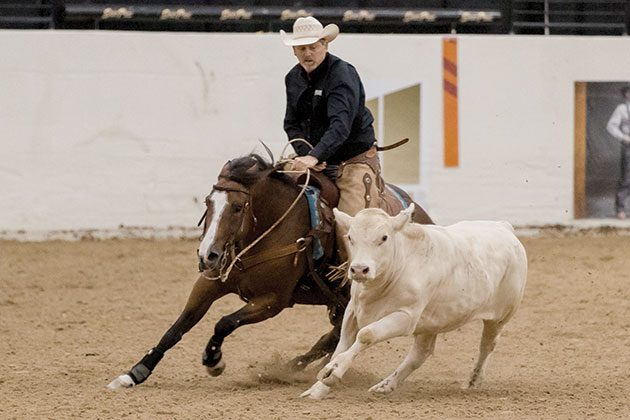
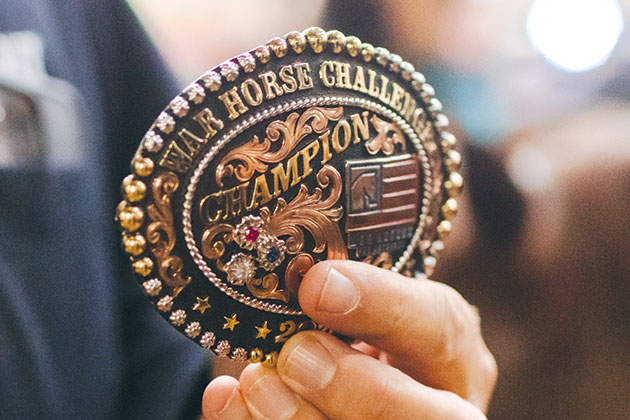
Mark Nutsch competed three times and twice won the War Horse Challenge, a premier reined cow horse event pitting veterans against veterans in the show pen that was cohosted by the National Stock Horse Association and the NRCHA’s Snaffle Bit Futurity.
Nutsch has also become an active supporter of War Horses for Veterans, which uses equine therapy to help active-duty service members, combat veterans and first responders heal from trauma and post-traumatic stress. He competed three times and twice won the War Horse Challenge, a premier reined cow horse event pitting veterans against veterans in the show pen that was cohosted by the National Stock Horse Association and the NRCHA’s Snaffle Bit Futurity.
Nutsch was also a pivotal figure in an underground movement known as “Operation Pineapple Express.” When Hamid Karzai International Airport in Kabul was struck by a suicide bomber in August 2021, and 13 American soldiers lost their lives. The ripple effect of the withdrawal of U.S. forces from Afghanistan, however, was felt far and wide. Numerous interpreters and allies who had assisted American troops during the war and their families became targets of the Taliban, who had since risen up 20 years after their ouster by coalition and Northern Alliance forces. Unable to escape, the former interpreters reached out to their contacts among the special operations forces, with Nutsch and several others springing into action for another mission.
“I got angry,” he says matter-of-factly. “These men had stood beside us in our darkest times. We desperately needed them, and they were there. Now, these same men and their entire families were trying to evade detection by the Taliban. They were targets because they had helped us, helped America, and they could not get out.” Nutsch immediately got involved with a volunteer group of veterans who worked to extract stranded American citizens, and six of ODA 595’s interpreters and their families, guiding them to safety and out of the Taliban’s grasp. Following that effort, he joined Shannon Spann, Mike Spann’s widow, and seven others, to create Badger Six, a nonprofit organization that “supports 35 families of the men who fought alongside CIA Team Alpha and the U.S. Army Green Berets of ODA 595,” according to the group’s website.
A proud American and entrepreneur, Nutsch relishes his time in the saddle, albeit back atop the Quarter Horses he prefers. His memories of Task Force Dagger remain striking, and his bond with his teammates unshakable. The impact their small team had in the first months of the Afghan War was immense to say the least. This group of tough-as-nails Green Berets assembled a coalition of 3,000 ethnic militiamen atop snarling Afghan stallions, to battle the Taliban and al-Qaida. The Americans were outnumbered and at a tactical disadvantage, but they were — and remain — 12 strong.
Request Platinum Magazine
Read inspiring stories of success, companionship and collaboration
At Platinum Performance, we love to showcase the success of our clients, their horses and the veterinarians that care for them. All issues of Platinum Magazine are complimentary.