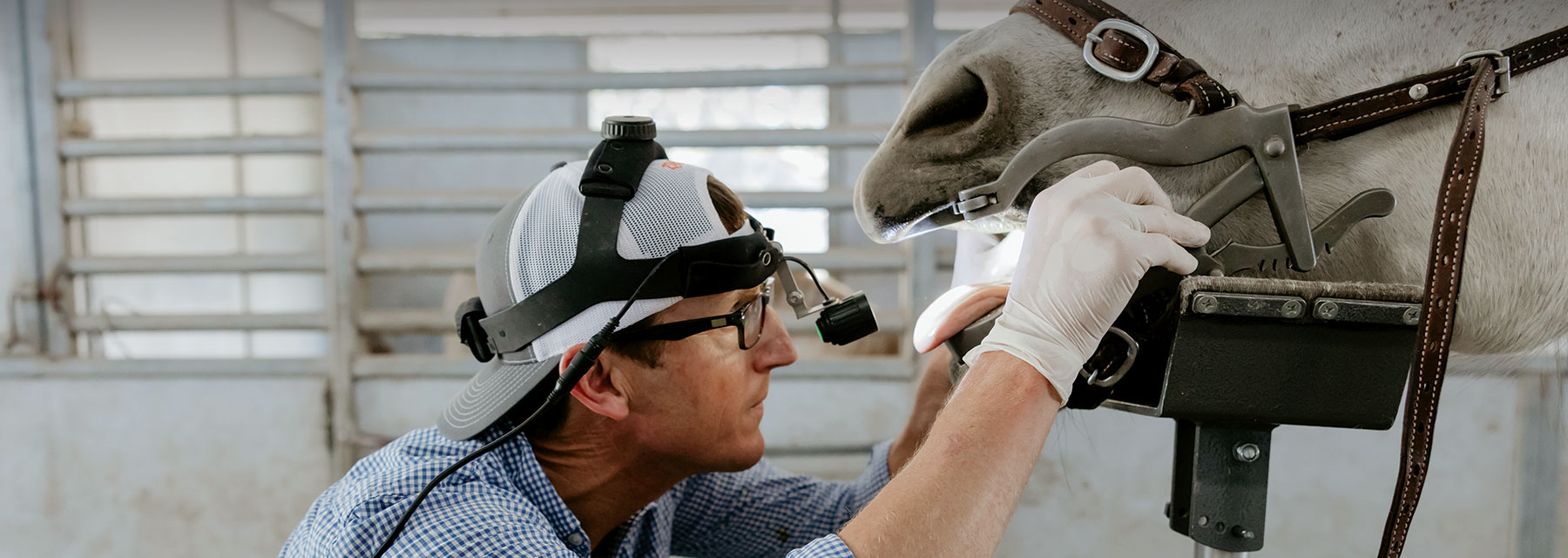
Dr. Geoff DeJayes performs an annual dental exam.
PHOTOS BY ELIZABETH HAY PHOTOGRAPHY
By
Emily Smith, MS
![]()
, Platinum Performance®

Emily Smith, MS
Platinum Performance®
Emily Smith, MS, has been an equine nutritionist at Platinum Performance® for over 15 years and has a passion for answering technical nutrition questions and finding the best diet for the individual horse. She has written many articles including The Power of Vitamin E, Feeding Frenzy: A Forage First Approach and The Joint File.
Anatomy, Function and Common Dental Problems
Dental health is a fundamental component of overall equine well-being and performance. Horses rely on their teeth to process forage efficiently. As grazing herbivores, this is of the utmost importance to maintain a healthy digestive tract and body condition. Horses evolved as foragers spending the bulk of each day chewing fibrous plants. Equine teeth have specialized structures and growth patterns that differ in major ways from carnivores or omnivores. These adaptations allow a horse to masticate large quantities of rough plant material but also make them susceptible to specific types of wear, malformation and disease.
Understanding the number, kind and arrangement of their teeth is not just necessary for veterinarians and equine dental technicians but also for horse owners, trainers and caretakers. Knowledge of tooth anatomy, eruption schedules and common dental issues will help ensure timely intervention and preventative care. Untreated, dental problems can lead to weight loss, behavior changes, poor performance and serious health complications.
Knowledge of tooth anatomy, eruption schedules and common dental issues will help ensure timely intervention and preventative care. Untreated, dental problems can lead to weight loss, behavior changes, poor performance and serious health complications.
The Basics of Equine Teeth
Horses have hypsodont teeth — teeth with long crowns that continue to erupt, or come out, throughout their lives. This compensates for constant wear caused by grinding fibrous vegetation. A mature adult horse typically has 36–44 permanent teeth, depending on gender (40-44 in males; 36-40 in mares) and the presence of certain vestigial teeth.
Equine teeth are divided into several categories based on function and location.
Incisors
Incisors are located at the front of the mouth. Horses normally have 12 incisors — six on the maxilla (upper jaw) and six on the mandible (lower jaw). The primary function is cutting or biting off plant material. Incisors also play a role in estimating a horse’s age because their shape and wear patterns predictably change over time. Immediately behind the incisors is the large interdental space, also called the bars, where the bit is placed.
Canines
More common in male horses, canine teeth, often referred to as Bridle Teeth, are located behind the incisors. Mares rarely develop them, although small canines may occasionally appear. Canines have little role in chewing and are considered vestigial structures, remnants from ancestral species used for fighting. Usually, there are four canines (two upper and two lower) that erupt between 4-6 years of age.
Premolars and Molars
Premolars and molars together are known collectively as cheek teeth. Most horses have 12 premolars and 12 molars, 24 total cheek teeth. They are located at the back of the mouth and perform the majority of chewing with surfaces containing ridges of enamel that act like grinding plates. As a horse chews, its lower jaw moves in a circular motion to crush and pulverize plant material into smaller particles to be swallowed.
Wolf
Some horses also develop small extra premolars, known as wolf teeth, often found in the upper jaw, just in front of the first upper cheek tooth. Usually appearing between 6-18 months of age, wolf teeth are also considered vestigial and serve no functional purpose. Sometimes, they are absent entirely or are frequently removed as they can interfere with the bit and cause discomfort.
Horses have hypsodont teeth — teeth with long crowns that continue to erupt, or come out, throughout their lives. A mature adult horse typically has 36–44 permanent teeth, depending on gender (40-44 in males; 36-40 in mares) and the presence of certain vestigial teeth.
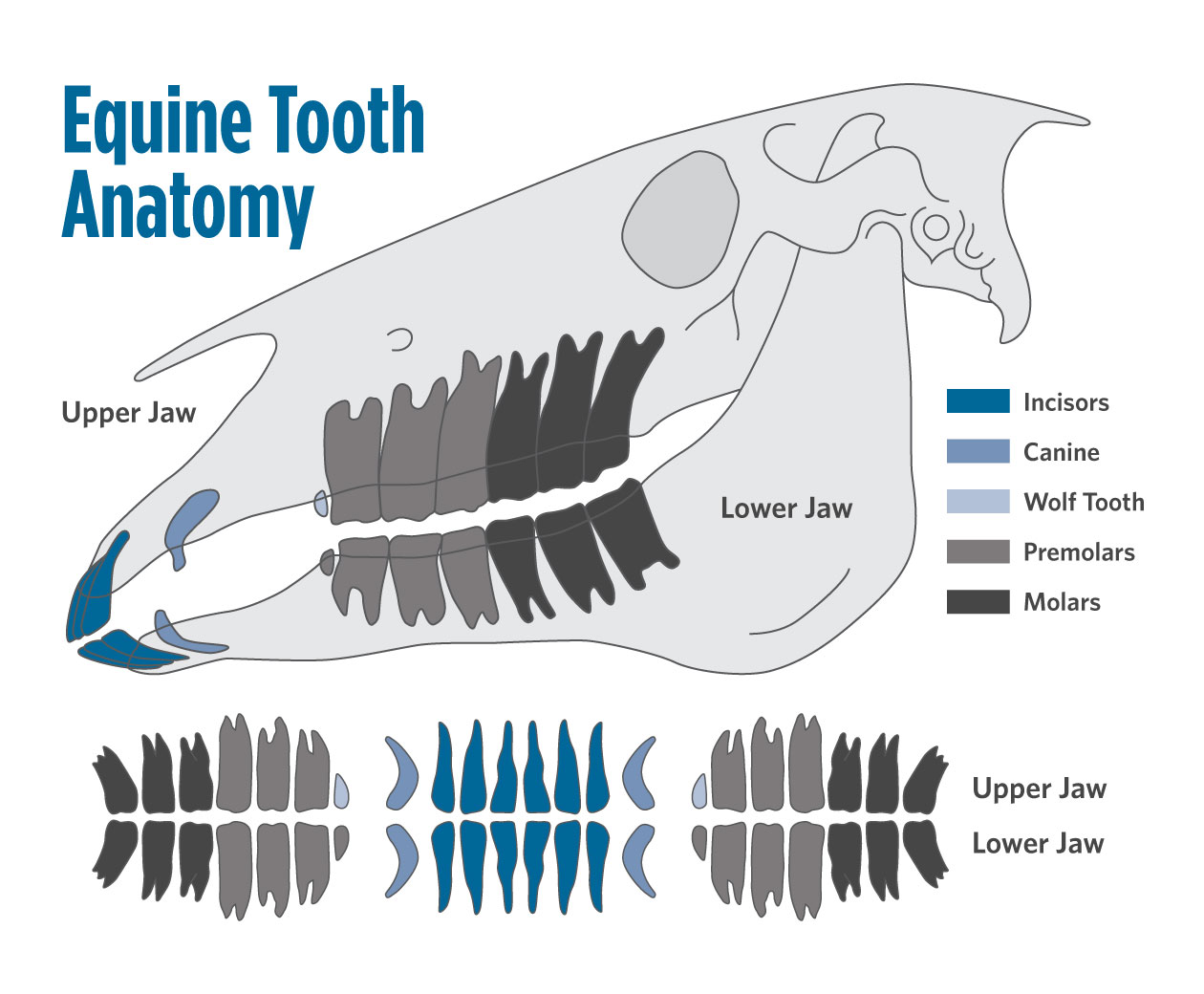
Equine Tooth Anatomy. ISTOCKPHOTO.COM/ADAPTED FOR PLATINUM PERFORMANCE®
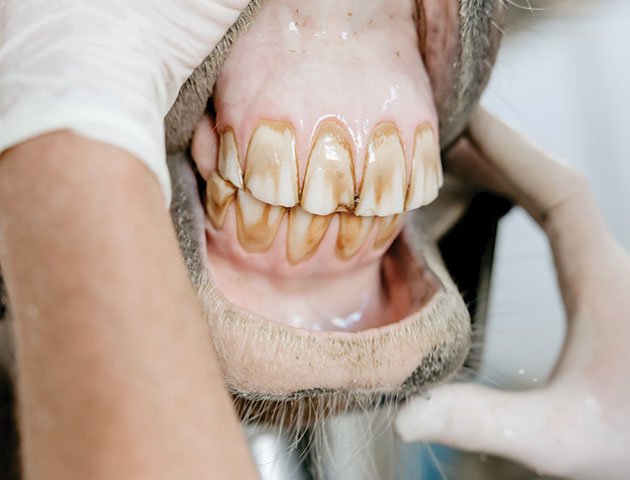
Horses normally have 12 incisors — six on the maxilla (upper jaw) and six on the mandible (lower jaw). The primary function is cutting or biting off plant material.
Equine Tooth Structure
Each equine tooth is a complex arrangement of calcified tissues with several structural layers that contribute to durability and grinding ability.
- Cementum is the outermost layer of the tooth that covers the outside of the tooth root and parts of the crown attaching the tooth and the periodontal ligament. In horses, it also fills the infoldings of enamel on the grinding surface.
- Enamel is the hardest substance in the body. In horses, enamel forms complex folds on the chewing surface that increase grinding efficiency. Unlike the other layers of the tooth, enamel is not able to heal itself if damaged.
- Dentin lies beneath the enamel and makes up the bulk of the tooth. It is slightly softer than enamel but still very strong.
- The pulp cavity contains nerves, blood vessels, lymphatics and odontoblasts — the cells that produce dentin to compensate for extreme, continuous tooth wear. Protected by the outer layers, if dental disease exposes the pulp, it can be very painful and lead to infection and disease.
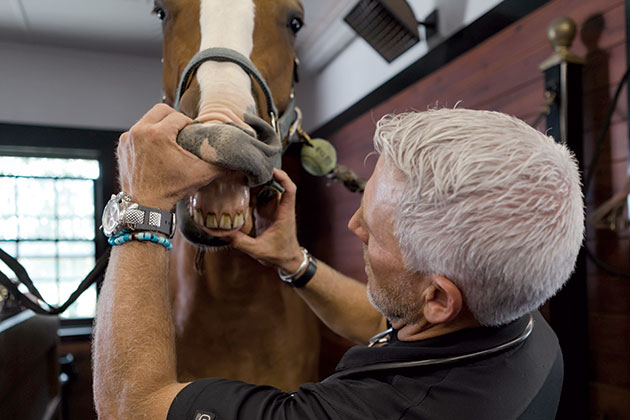
Your horse's teeth should be checked once a year by a veterinarian. Checkups may be recommended more frequently, especially in young or old horses, or those with a history of dental problems. Dr. Chad Davis performs an exam.
Troubleshooting Common Equine Dental Problems
Dental disease is common in horses with many issues arising from uneven wear due to the anatomy of the equine jaw. Horses chew using a side-to-side grinding motion with the lower jaw moving laterally rather than an up-and-down bite. Food is crushed between upper and lower cheek teeth, and saliva mixes with the bolus to begin digestion. Because horses evolved to graze up to 18 hours a day, their teeth can accommodate the near-constant grinding. Diets that differ significantly from natural grazing can contribute to dental problems. To help prevent these, your horse’s teeth should be checked once a year by a veterinarian. Checkups may be recommended more frequently, especially in young or old horses, or those with a history of dental problems.
Enamel Points
One of the most frequent dental problems is the formation of sharp enamel points. Because the upper jaw is wider than the lower jaw, sharp edges can form on the outside of upper cheek teeth and on the inside of lower premolars and molars that can cut a horse’s cheeks or tongue.
Signs of Enamel Points:
- Dropping feed (quidding)
- Head tossing
- Resistance to the bit
- Weight loss
- Excess salivation
Hooks
Hooks, another dental issue, are overgrowths that develop on the front or back of cheek teeth. Hooks are overgrowths where the molars do not meet evenly, and normal wear is disrupted. Usually, the uppers are slightly forward of the lower molars. The chewing fails to grind part of the first upper molar while also failing to grind the back part of the last molar. Over time these two areas form longer and longer points that may press into the opposing gum and cause pain while chewing.
Wave Mouth
Wave mouth occurs when alternating cheek teeth become uneven in height, creating a wave-like pattern. Normal occlusion is when the upper molars meet the lower with a slightly upward slope from front to back, but each tooth matches the adjacent teeth evenly. Instead, the teeth develop a wave-like formation, leading to uneven wear as the horse ages that reduces chewing efficiency, causes abnormal tooth wear and potentially leads to digestive issues. Gradual dental adjustments over multiple treatments are often required to correct wave mouth.
Step Mouth
Step mouth develops when one tooth grows excessively long because its opposing tooth is missing or damaged. Without an opposing tooth to wear it down, the tooth continues erupting, making it difficult for the animal to chew and can lead to periodontal disease.
Diastema
A diastema is an abnormal gap between adjacent incisor or cheek teeth where food becomes trapped. Horses with a diastema may require dental reshaping and regular cleaning.
Food accumulation can lead to:
- Gum infection
- Periodontal disease
- Foul mouth odor
- Chewing pain
Tooth fractures, tooth root infections, abscesses and plaque buildup are other dental problems that can cause significant issues.
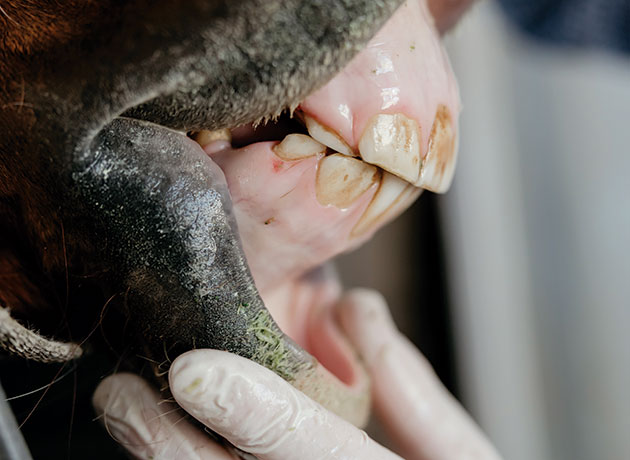
The upper and lower incisors are not meeting normally showing misalignment of the front teeth, which would be considered mild parrot mouth.
Tooth Timeline
Deciduous Teeth
(Baby or Milk Teeth)
Like humans, horses have two sets of teeth during their lives, a set of baby teeth that fall out, and a set of permanent teeth developing later. Foals are born with or quickly develop temporary teeth known as deciduous teeth. A foal typically has 24 deciduous teeth — 12 incisors and 12 premolars — emerging in pairs. These teeth or caps are gradually replaced by permanent teeth as the horse matures.
Baby Teeth Timeline
(Approximate eruption ages)
- Central incisors: birth to 1 week
- Intermediate incisors: 4–6 weeks
- Corner incisors: 6–9 months
Permanent Teeth
Permanent teeth begin coming in around 2.5 years of age and usually finish by age 5. Once permanent dentition is complete, the horse is considered to have a “full mouth.”
Approximate Eruption Timeline:
- Central incisors: 2.5 years
- Intermediate incisors: 3.5 years
- Corner incisors: 4.5 years
- Canines: 4–6 years
- Molars: Between 1–4 years
Continuous eruption is a distinctive features of equine dentition. Equine cheek teeth have long reserve crowns embedded in the jaw. As the grinding surface wears down from chewing, more of the tooth slowly emerges at 2–3 millimeters per year.
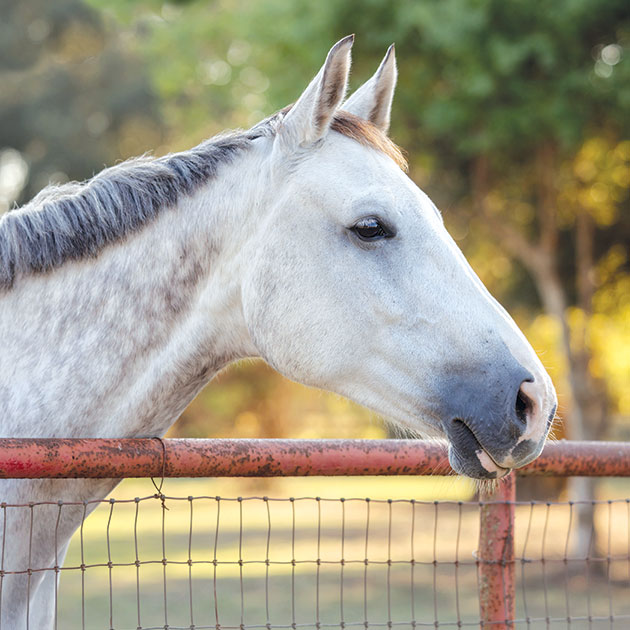
Tooth examination can provide estimates of equine age. These are based on eruption, wear patterns of the teeth, appearance of certain markers and changes in shape and angle.
Determining Equine Age Based on Teeth
Although documentation today often makes it unnecessary to establish the age of a horse, tooth examination can still provide estimates of equine age. These are based on eruption, wear patterns of the teeth, appearance of certain markers and changes in shape and angle. A horse replaces its deciduous or baby teeth with a full set of permanent teeth by age 5. Determining age by teeth becomes less accurate after the horse is about 10 years of age. Diet and genetics can influence wear, making precise aging difficult in older horses.
Key features for aging:
- Eruption of permanent teeth: full set by age 5.
- Wear patterns: certain telltales appear or disappear as the horse matures including cups, dental stars, hooks and Galvayne’s groove on the upper-corner incisor.
- Cups (the dark, hollow center of the infundibulum) disappear from lower teeth by 6 to 8 years old and upper teeth by 9 to 11 years old.
- Angle: Young horses have straighter, up and down teeth. As a horse ages, incisor angle generally becomes more acute, slanting forward.
- Shape: The shape of teeth in young horses is oval, broad and flat. The surface will become more round at about 8 to 12 years old and then triangular at about age 15.
Wear Patterns
Cups
Cups are at the center of the top of the incisors with a brown infolding, or cupped look, and wear away over time. In general, cups are completely worn away first on the lower incisors between ages 6-8. The upper incisors follow between ages 9-11. When all the cups are gone, the horse is referred to as smooth mouthed, and will begin to develop dental stars on the flat surface of the teeth.
Dental Star (Pulp mark)
A dental star appears after some wear has occurred on dentin of the incisors, exposing the central pulp cavity. What starts as a dark line, changes to a round spot as the occlusal surface is worn away. Usually very visible by age 8 on the lower central incisors, the other incisors typically show dental stars by 10 to 12 years old. Despite the appearance of the pulp cavity, the tooth protects itself by laying down a hard, protective layer of irregular secondary dentin.
Hooks
A small hook, or overhang, may appear on the upper corner incisor around age 7, disappearing by age 8. It reappears around 11 to 13 years of age, again disappearing about one year later.
Galvayne’s Groove
Galvayne's groove is a darkened, vertical line that occurs on the upper corner incisor. It generally first appears at the gum line at age 10, moving down the tooth over time. It reaches halfway down the tooth by age 15, and goes from the midpoint to the bottom of the tooth by age 20. The groove then begins to disappear, usually half-way gone by age 25 and not visible by age 30.
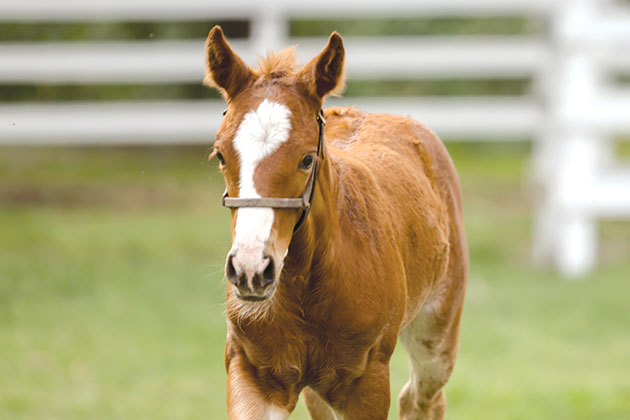
Teeth Aging Milestones
- Birth – 1 year: Temporary (“baby”) incisor teeth appear, all are present by age 1. The foal’s 24 deciduous teeth include 12 incisors and 12 premolars. Teeth are small and very white.
- 2 1/2 – 3 years: Central permanent incisors erupt replacing baby teeth.
- 3 1/2 - 4 years: Intermediate permanent incisors come in.
- 4 1/2 - 5 years: Corner permanent incisors erupt; full mouth of permanent teeth by 5 years.
- 5 – 7 years: Canine teeth appear in males; teeth are “in wear.”
- 6 – 8 years: Cups disappear from lower incisors.
- 9 – 11 years: Cups disappear from upper incisors.
- 10+ years: Galvayne’s groove (A dark line on the upper third incisor) appears at the gum line, reaching halfway down the tooth by 15, and the whole tooth by 20 before receding and disappearing by age 30.
- 15+ years: Teeth appear longer, more triangular, and meet at an increasingly sharp angle.
Older Horses and Dental Issues
As horses age, their teeth eventually wear down. Regular dental monitoring and veterinary check-ups are particularly important for senior horses that are more likely to have loose or missing teeth and reduced grinding surfaces. These changes can lead to difficulty chewing long-stem forage. Dietary adjustments for seniors may include utilizing chopped forage, soaking feed or providing a complete feed if forage is too difficult to chew.
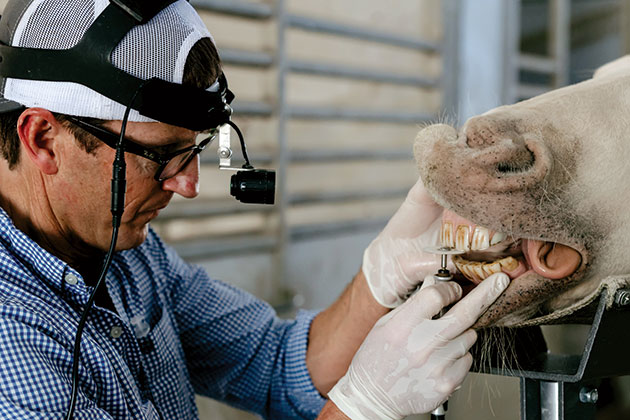
Floating teeth — filing sharp edges and correcting misalignments on the surface of teeth — provides several benefits, such as improved chewing efficiency, reduced pain and better performance.
What is Floating Teeth?
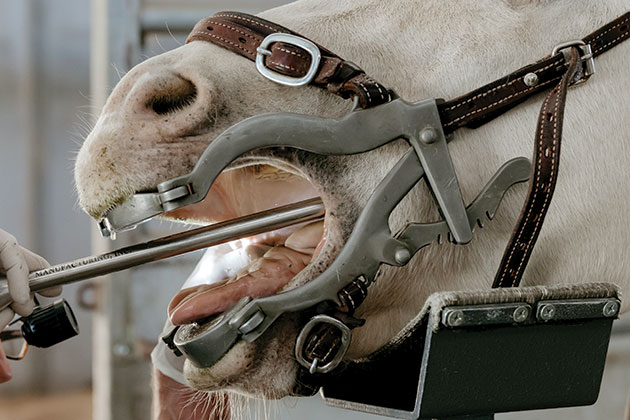
Dental floating, or floating teeth, is the process of filing sharp edges and correcting misalignments on the surface of teeth. It can be performed manually or with power instruments with the horse under sedation by a veterinarian or technician specifically trained in equine dentistry. Floating teeth provides several benefits, such as improved chewing efficiency, reduced pain and better performance.
Advanced Dentistry
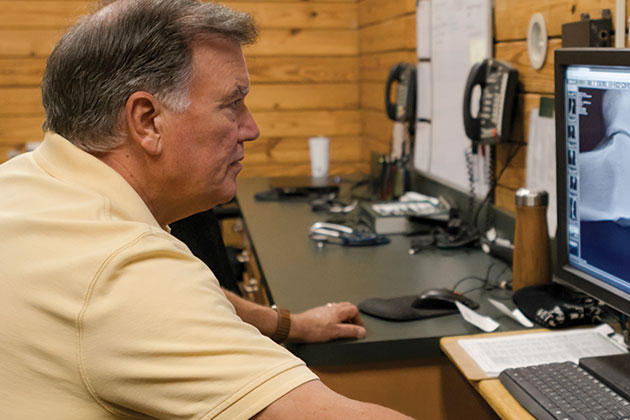
Modern equine dentistry has advanced significantly with the use of specialized tools and imaging techniques to diagnose and treat complex dental conditions. Radiographs, endoscopy, tooth extraction and surgery and advanced corrective dentistry can be used for early intervention and improved outcomes that prevent chronic pain. Sedation of the equine patient during treatment is used to protect the animal and the veterinarian.
Diet and Dental Health
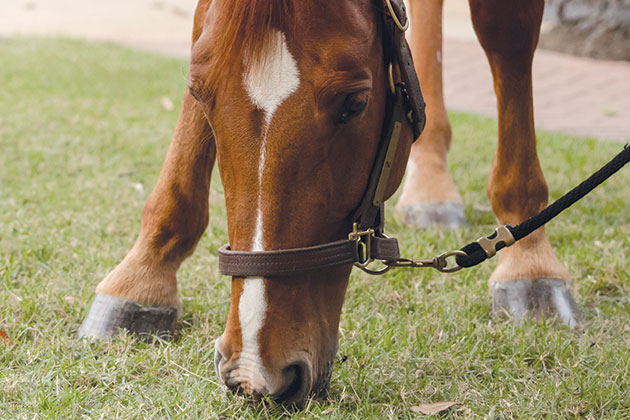
The diet plays an important role in maintaining healthy teeth in a horse. High-fiber forage diets promote natural wear patterns on the teeth. Conversely, horses fed mainly concentrated feeds may chew less, allowing sharp edges to develop more quickly. Providing a balanced diet with adequate pasture or hay and clean, fresh water supports overall oral health.
The primary function of the incisors is cutting or biting off plant material while the premolars and molars are located at the back of the mouth and perform the majority of chewing with surfaces containing ridges of enamel that act like grinding plates.
Signs of Dental Problems in Horses
Horses often mask dental pain, so subtle signs may be the only clues. Regular dental examinations are a key part of equine management and essential for early detection of problems. Most veterinarians recommend annual dental exams, although young or elderly horses may require more frequent evaluation.
Symptoms of dental problems:
- Dropping partially chewed feed (quidding)
- Slow eating
- Weight loss
- Head tilting or tossing, especially while chewing
- Excessive salivation
- Bad breath
- Nasal discharge
- Facial swelling
- Resistance to the bit
- Behavioral changes
Proper dental care is not simply a maintenance task; it is a critical aspect of responsible equine management and long-term animal welfare. Equine dentition is a highly specialized system adapted for grazing and masticating fibrous plant material. Every part of the mouth plays a role in predigestion, nutrition and performance. With up to 44 teeth and a lifelong process of eruption and wear, the horse’s mouth is both remarkably durable and uniquely vulnerable to dental problems. Regular exams, coupled with proper nutrition and timely treatment are essential to maintaining equine oral health to ensure that your horses remain comfortable, healthy and capable of grazing forage as they are meant to.
Request Platinum Magazine
Read inspiring stories of success, companionship and collaboration
At Platinum Performance, we love to showcase the success of our clients, their horses and the veterinarians that care for them. All issues of Platinum Magazine are complimentary.