PHOTO BY ELIZABETH HAY PHOTOGRAPHY
By
Lindsey Stornetta
![]()
, Platinum Performance®

Lindsey Stornetta,
Platinum Performance®
Lindsey Stornetta has been assisting equine veterinarians and high-level riders with her expertise in advanced nutrition for over 15 years. A lifelong horsewoman and competitive barrel racer herself, Lindsey has a deeply held passion for all aspects of the equine world, from high performance sport to the intricacies of veterinary medicine.
Don’t Be Fooled By This Natural Phenomenon; It’s Usually Not the Source of a Horse’s Lameness
The foundation of soundness for a horse is the health and symmetry of its feet. With such large body compositions supported by tiny hooves, the feet must be balanced to withstand heavy loads. With up to 95% of horses showing hoof imbalances, which can be precursors to disease, it’s important to be aware of a horse’s hoof condition and report any changes to the veterinarian immediately. One such condition that can sneak up on a horse (and its owner) because the signs are so minimal is called sidebone. While the name sounds serious, the prognosis is not terrible with most cases never experiencing lameness. We caught up with Matt Durham, DVM, DACVSMR, Platinum’s senior technical services veterinarian, to learn more about this mysterious phenomenon.
What is Sidebone?
Sidebone is defined as the ossification or hardening of the collateral cartilages of the hoof into bone, most commonly found on the outside of the front feet.
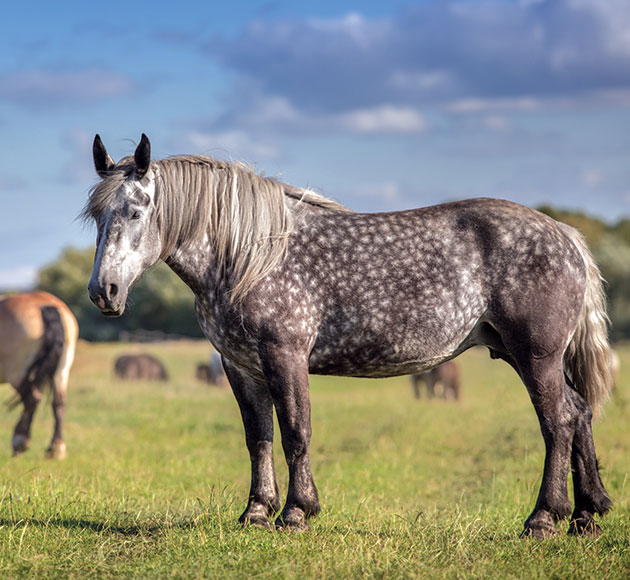
Sidebone has been linked to large breeds like drafts or warmbloods. These heavier horses put more pressure on their feet, warranting the need to strengthen the structures.
Sidebone has been linked to large breeds like drafts or warmbloods. These heavier horses put more pressure on their feet, warranting the need to strengthen the structures.
What is Sidebone?
Sidebone is defined as the ossification or hardening of the collateral cartilages of the hoof into bone, most commonly found on the outside of the front feet. “The collateral cartilage is like the cartilage in the ear or nose, so it’s fairly rigid, and it runs from the back of the hoof to the coffin bone,” Dr. Durham explains. “Its purpose is to hold the shape of the heel bulbs. Otherwise, there’s really nothing very solid back there.” This cartilage connects to most of the major bones in the foot, including the pasterns, coffin and navicular bones, making it an important shock absorber for weight, trauma and stress.
While the exact cause of sidebone is unknown, the condition has been linked to large breeds like drafts and warmbloods. “It’s really common in heavier horses,” Dr. Durham says. “You rarely see it in ponies because a lot of it has to do with the massive loading that happens in the foot.” This added pressure requires the hoof to be strong to bear the weight of the horse. “For whatever reason in these sidebone cases, the body feels the need to strengthen that structure and one of the ways it can do that is turning (cartilage) into bone,” he says. Other risk factors that haven’t yet been proven but may predispose horses to sidebone include poor shoeing or trimming, training on uneven or hard ground consistently, trauma or injury of the collateral cartilage and conformation faults to the feet, including horses that are both toed-in or toed-out.
What Could Predispose a Horse to Sidebone?
- Large breeds
- Horses with a heavy front end
- Poor shoeing or trimming
- Training on uneven or hard ground consistently
- Trauma or injury of the collateral cartilage
- Conformational faults (toed-in or toed-out)
“For whatever reason in these sidebone cases, the body feels the need to strengthen that structure and one of the ways it can do that is turning (cartilage) into bone.”
— Matt Durham, DVM, DACVSMR, Platinum’s Senior Technical Services Veterinarian
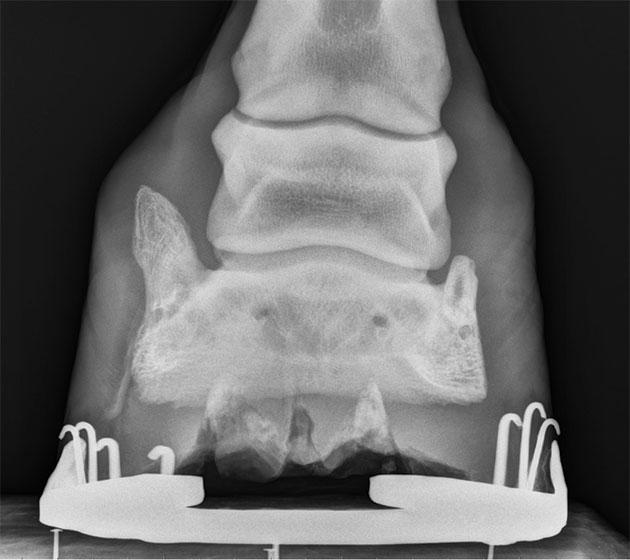
“In general, for most horses, it’s not a source of lameness,” says Dr. Matt Durham. “It gets blamed a lot of times because it’s there and easy to see radiographically, but often it’s an incidental finding.”
COURTESY PHOTO
“In general, for most horses, it’s not a source of lameness,” says Dr. Matt Durham. “It gets blamed a lot of times because it’s there and easy to see radiographically, but often it’s an incidental finding.”
COURTESY PHOTO
Symptoms
While most horses don’t exhibit lameness with sidebone, it is easily spotted and looks alarming on an X-ray. “In general, for most horses, it’s not a source of lameness,” says Dr. Durham. “It gets blamed a lot of times because it’s there and easy to see radiographically, but often it’s an incidental finding.” The boney protrusions can also be felt by palpating on the outside of the pastern, and severe cases may even be sensitive to touch. Horse owners are usually in shock when seeing them so plainly on the X-ray because their horses are generally showing no signs of being sore. “Even if the horse is limping, and we know that sidebone is present radiographically,” Dr. Durham says, “I’m usually looking for something else because it’s uncommon for that to be the cause.” One of those potential problems is an injury to the collateral ligament of the coffin joint that stabilizes both sides. This injury has been correlated with the presence of sidebone. For this reason, medial- lateral balance of the hoof is a critical issue in affected horses.
The main sidebone risk factor is that this fine bone is very sensitive. If and when a horse hits this bone on something, it can be extremely painful like stubbing your small toe on the edge of a wall. A horse may limp severely for a few days until the inflammation calms down. This bone also has a higher risk of being fractured because of its frailty and location. The challenge is that these breakages can be very hard to detect because they are so small. “Fractures of sidebone are actually quite painful when they happen,” Dr. Durham says. “They usually resolve fairly well, but sometimes some instability in the area can keep them somewhat sore.” Another concern with sidebone is when it grows into other spaces. “One of the things that can cause a problem with sidebone is if it grows inward toward the short pastern bone, then it can potentially impinge on some of those other tissues, and that can be very painful,” he adds. Fortunately, this is only seen in very severe cases.
Maintaining Affected Horses
Sidebone should be monitored for significant changes but not treated unless a horse exhibits lameness due to a fracture or bruise. “There’s not really a treatment for sidebone, unless the horse has a fracture, in which case you would need to rest the horse and allow it to resolve,” says Dr. Durham. These cases require stall rest, icing and anti-inflammatories (nonsteroidal anti-inflammatory medication) to calm the affected area. Once recovered, generally within about three to six months, horses should be able to return to full work.
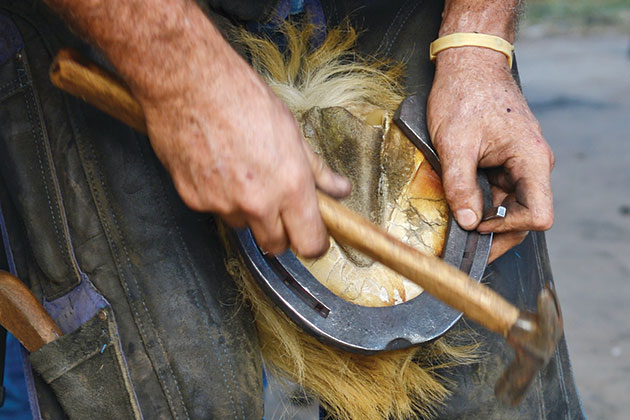
Shoeing can also play a role in balancing the foot. “For me, sidebone is a clue that I should pay really close attention to the balance of that foot to make sure that we’re not getting a little bit out of whack,” Dr. Durham says. “There may be some uneven loading in the foot, and that might give the farrier one more piece to the puzzle.” A veterinarian may recommend different strategies for corrective shoeing. These include using a shoe with a rolled toe to help ease breakover, a padded shoe to help ease concussion, or a wide-webbed shoe (up to double the width of a standard shoe) to redistribute pressure putting less stress on internal foot structures. Most importantly, these patients should be kept on a regular sixweek trimming schedule to maintain hoof balance and symmetry.
Ideally, horses with sidebone should wear protective boots and only be ridden on softer ground. Supplementation with omega- 3 fatty acids, turmeric, silicon and potent joint ingredients like glucosamine and ASU (avocado/soy unsaponifiables) help support healthy levels of inflammation and cartilage health. It is important to remember once sidebone is present, it’s there to stay. The task then is to find the best way to manage the condition, help the horse stay comfortable and keep the sidebone from growing and causing problems.
Maintaining a Horse with Sidebone
- Always use protective boots when riding
- Consistent trimming and shoeing (every six weeks)
- Corrective shoeing as directed (rolled toe, pads, or wide-webbed shoes)
- Exercise only on soft ground
- Supplement with omega-3 fatty acids, turmeric, silicon and potent joint ingredients
As The Hoof Grows
While a sidebone diagnosis can seem extremely scary to a horse owner, most horses live and perform comfortably with the condition. In fact, it is believed that up to 80% of horses worldwide show a minor degree of sidebone in X-rays, and most never display any outward symptoms.
With this type of condition, helping to maintain balanced and healthy feet can go a long way for equine health because if there’s no hoof, there’s no horse.
Request Platinum Magazine
Read inspiring stories of success, companionship and collaboration
At Platinum Performance, we love to showcase the success of our clients, their horses and the veterinarians that care for them. All issues of Platinum Magazine are complimentary.