COURTESY PHOTOS
By
Jessie Bengoa, MS
![]()
, Platinum Performance®

Jessie Bengoa, MS,
Platinum Performance®
Jessie Bengoa, MS is the author of recent articles on Equine Kissing Spines, Equine Gastric Ulcer Syndrome and Equine Herpes Virus. In addition to being a lifelong horsewoman, Jessie has over 17 years of experience in the world of food and nutrition with special expertise in equine nutrition.
Dr. C. Scott Bailey Builds a Storied Career in Equine Reproduction, Furthering Science and Serving the Horse in His Journey from Kentucky’s Revered Bluegrass Country to the Cornell University Campus
There was never any question that Dr. C. Scott Bailey knew precisely what he was meant to do from childhood. Destined for veterinary medicine, he pursued the dream with an unrelenting spirit and steadfast determination. “I imagined myself to be James Herriot,” he remembers, referencing the widely admired British country veterinarian who authored eight beloved classic books set in the 1930-50s Yorkshire Dales under the pen name, James Herriot. “I saw myself in mixed animal practice, doing a little bit of everything,” he says of his adolescent dreams. Raised in a military family, he enjoyed a worldly upbringing in Germany where, throughout his travels, he was continuously drawn to animals. Back on American soil to attend veterinary school at Kansas State University, he had a revelation that would shape his career: “I realized that I was actually pretty good with horses,” he says. Gone were his dreams of morphing into a modern-day iteration of “All Creatures Great & Small”; he would serve horses exclusively. “I was drawn to them not just from a medicine perspective, but I can read their body language. And I’m comfortable around them,” he says with clear reverence for the creatures he serves. “There were others in veterinary school who were probably much better veterinarians than me,” he says humbly, “but they didn’t have the same innate sense of anticipating what a horse was going to do.”
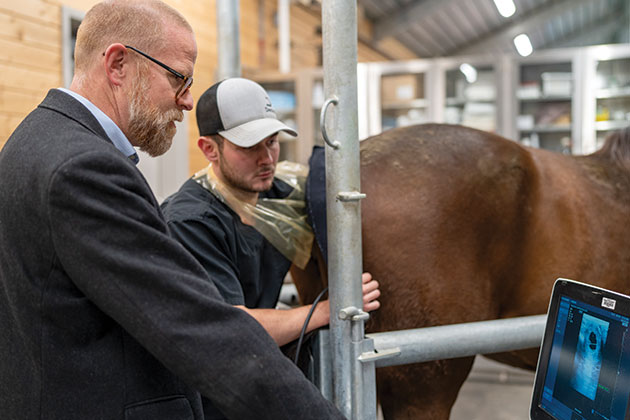
After earning his veterinary degree in 2003, he left Kansas for an internship at Saratoga Springs Equine Veterinary Services (now known as the Equine Clinic of Saratoga) in Saratoga Springs, New York. There, and under the tutelage of veterinarians Bill Barnes and Axel Sondhof, the young Dr. Bailey quickly saw a need for the practice to offer reproductive services to its growing clientele. “Drs. Barnes and Sondhof were surgeons, and I thought, ‘Well, if I do the reproduction, it’ll round out the practice and also allow me to build my own identity.” Dr. Bailey dove into the equine reproduction specialty with his signature curiosity, voraciously absorbing continuing education to build a knowledge base to become one of the most versatile and studied in the industry. His mentors at the clinic encouraged him to pursue an advanced degree and pointed him toward the University of Florida where he would complete a residency in theriogenology (encompassing all aspects of veterinary reproductive medicine and surgery). The program allowed for two years of clinical study within academia, then a third year of field work in Kentucky. With both facets of the program complete, Dr. Bailey soon left bluegrass country and returned to the University of Florida to complete a master’s program in veterinary clinical sciences. Upon earning his final advanced degree, he moved up the coast in 2009 to join the faculty at North Carolina State University’s College of Veterinary Medicine, finding his passion as an educator. “I was doing everything there that I had dreamed of doing,” he recalls of his days in Wolfpack country. “There was research and the pursuit of new knowledge, and sometimes even old knowledge in a new way.” He rediscovered a love for academia that he once thought to have lost in favor of field work. “My mind is always wondering, ‘Why does that really work?’ And there (at North Carolina State), I had the freedom to answer those questions. That’s a privilege that you only have in an academic setting, and I really love that.” As an assistant professor in theriogenology his clinical interests included advanced reproductive techniques and reproductive diseases. As a researcher, Dr. Bailey’s work focused on bacterial causes of pregnancy loss.
“My mind is always wondering, ‘Why does that really work?’”
— C. Scott Bailey, DVM, MS, DACT, Cornell University College of Veterinary Medicine
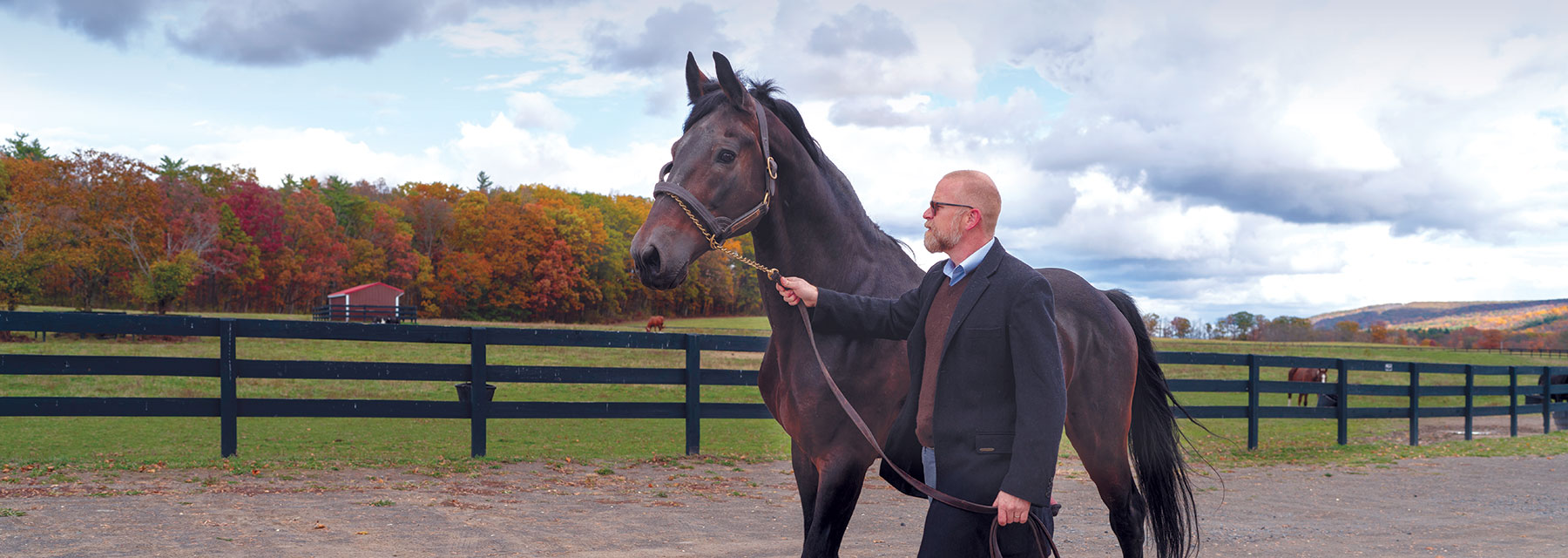
Dr. C. Scott Bailey is an associate professor and veterinarian at Cornell University, an Ivy League school in Ithaca, New York, and a pillar in the world of veterinary academics and research.
Dr. C. Scott Bailey is an associate professor and veterinarian at Cornell University, an Ivy League school in Ithaca, New York, and a pillar in the world of veterinary academics and research.
Though fulfilled and happy, life had other plans for Dr. Bailey. After more than a decade, he received an offer he simply couldn’t refuse, and, in 2019, he and his young family packed up and moved nearly 500 miles northwest to Paris, Kentucky, back in the heart of Horse Country to join the storied Thoroughbred operation, Claiborne Farm, as resident veterinarian. For over a century, Claiborne has been a Kentucky institution. Known as “The Birthplace of Champions,” the farm foaled and raised 10 Kentucky Derby winners from 1930 to as recent as 2013. Six of the 13 winners of the coveted Triple Crown were sired here, from Galant Fox in 1930, Secretariat in 1973 to Seattle Slew in 1977. Claiborne has topped the nation’s leading sire list an astounding 29 times and the broodmare sire list an impressive 42 times. Over 300 champions were sired by Claiborne stallions, including 22 Kentucky Derby winners, 20 Preakness Stakes winners, 23 Belmont winners and 99 winners of the Breeders’ Cup. The National Racing Hall of Fame has inducted 24 horses foaled and/or raised at Claiborne Farm, with 16 Claiborne mares honored as Broodmare of the Year, and the farm itself earning the title of Leading Breeder on 11 occasions, including a pair of Eclipse Awards for Outstanding Breeder. To say Claiborne’s breeding program is legendary within the international Thoroughbred industry is a glaring understatement.
Dr. Bailey worked not just to continue the Claiborne legacy but to build on it, improve its procedures and help advance the farm into its next 100 years of greatness in the breeding barn. “At Claiborne Farm, one of the things that I really was interested in and continue to be interested in is figuring out how to optimize the mare’s cycle in terms of fertility and how to optimize pregnancy rates in any setting, whether it be live cover or artificial reproductive techniques,” he says. “The thing we can’t forget is that for a mare’s uterus to be healthy, the mare herself has to be healthy. Regardless of what techniques are ultimately used to put the sperm and the egg together, the underlying health of the animal is important, both for the donors and then ultimately for the mare that will carry the pregnancy.” In live cover reproduction, where a stallion and mare physically mate, Dr. Bailey looked intently into the effects of various common reproductive treatments, carefully analyzing results and exploring how to improve treatments. “For decades, the idea has been that if we just try often enough or put antibiotics into the uterus of a mare, that we’ll improve the pregnancy rate from, let’s say, 65% to 70% for example. But most of those treatments have been empiric, meaning we’re trying something that we think works, but we haven’t actually ever gone back to look carefully and be sure. We haven’t designed an optimal program.” At Claiborne, Dr. Bailey had access to 220 horses that could double as research animals every year. He was able to directly compare treatments over his six-year tenure, creating a massive database by equine research standards. “I was able to look at specific treatments and gather ideas on how to optimize, he says.”
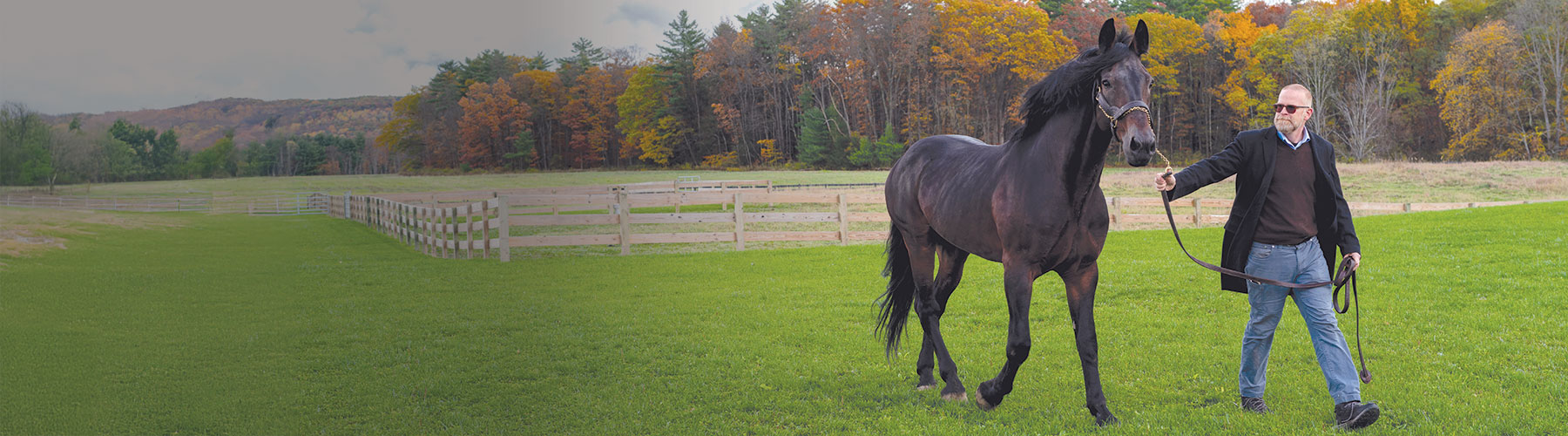
One area Dr. Bailey zeroed in on with Claiborne’s breeding program was the effect nutrition has on supporting fertility and the overall health of both mares and stallions. “Nutrition is medicine,” he points out. “During my last few years at Claiborne Farm is when PlatinumVET™ Reproductive Care came out. I think we had enough for six horses that first year. We put a few barren mares on the product who hadn’t gotten pregnant in several cycles, as well as a few mares that had just come off the track. The staff just couldn’t say enough good things about it. So, the subsequent year, we bought enough to give to half the barren mares and half of the maiden mares. The differences were astounding when I started to analyze pregnancy rates in the maidens.”
As a strong advocate for the overall health of the horse, Dr. Bailey considers himself a veterinarian first and then a theriogenologist. He believes that without optimal total body health, the horse as a breeding animal will not perform to its highest potential, whether that be in live cover or assisted reproduction. “The advancements in the assisted reproduction arena are pretty amazing,” he says of equine reproduction involving the laboratory and science. “Even in the last two years, there are things that are happening that are likely to change the industry for most veterinarians,” he says. “We’re now seeing publications on in vitro fertilization (IVF) in horses. A lot of people think of IVF and intracytoplasmic sperm injection (ICSI) as the same thing, but they’re not. In vitro fertilization is successfully done in other species by putting an egg and some sperm together in a tube or a petri dish to make an embryo that’s implanted to then grow into a baby. That process had never been done successfully in the horse for a long time.” The equine world has instead relied on ICSI, where a single sperm is injected into a single egg under a very high-powered microscope with micromanipulators that take human movement down to a microscopic level. “ICSI is both labor and time intensive and typically only done in very specialized practices,” he says. The major difference with IVF is that it can be done in a private practice by a much broader swath of veterinarians, making it more available and at a much lower cost. With this treatment breaking through into equine reproductive medicine, there could be a seismic shift in assisted reproduction, forever changing the game for breeders and their veterinarians.
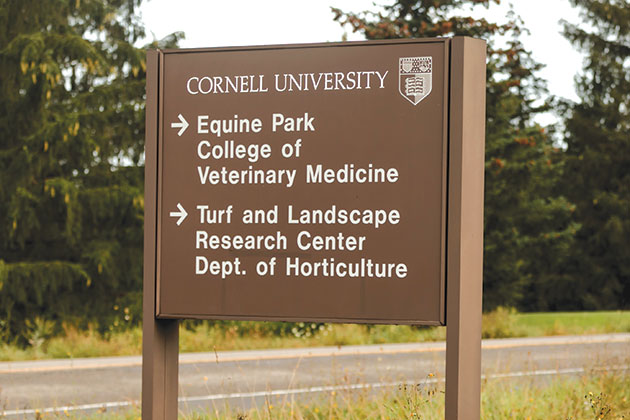
Amid this revolutionary time in theriogenology, Dr. Bailey made another significant life change. In September, he bid farewell to the magical days spent working in Claiborne’s legendary breeding program and accepted a position as associate professor and veterinarian at Cornell University, an Ivy League school in Ithaca, New York, and a pillar in the world of veterinary academics and research. “I’m still in the phase of being scared by it,” he says with a chuckle. “It really is motivating and exciting. Cornell is a special place; it’s one of the oldest veterinary schools and probably one of the most preeminent research institutions. My dad was actually born in Ithaca, and he brought me to Cornell to look at the veterinary school. I thought, ‘Someday I’m going to go to vet school there.’ They turned me down; I didn’t get into vet school here,” he says with a smile. “Now, to be later in life and at this point in my career and to be back here, it’s a triumph in ways, overcoming one of the early stumbling blocks in my pathway.”
Here in these hallowed halls of this 160-year-old private institution, Dr. Bailey looks forward to further challenging the ways he and other veterinarians have always done things. He’s throwing himself into research, seeking answers to questions in the hope of furthering science and bringing improved clinical tools to reproductive veterinarians everywhere. “We may have always done it a certain way, but why? And how exactly does it work, and could we do better?” he asks rhetorically. “If we can start to better understand how drugs are working, how nutrition is working and really start to better understand what we’re doing and why we’re doing it, then I think that we can take several steps forward in a fairly short period of time.” While IVF will certainly be among his areas of focus, he has big ideas, innumerable questions and a persistently curious mind that will now explore unchecked at Cornell. “The driving force for me is research; it’s the opportunity to learn,” Dr. Bailey says. “Learning is ultimately what excites me but also the opportunity to interact with people that have very different interests. Academia facilitates that so easily, and it can result in collaboration and new thought.”
So begins the next chapter of Dr. C. Scott Bailey’s story; told in the lush landscape of the Northeast and within Cornell’s stately campus. When days wind to a close, Dr. Bailey makes the short drive to the family’s charming country farmhouse, set in a tranquil meadow and surrounded by foliage. Veterinary medicine isn’t singular in this family, with Dr. Bailey’s wife, Dr. Stasia Bembenek Bailey being a fellow veterinarian. Instead of horses, her focus is lab animals and ensuring both the validity of research performed using a lab animal model and the care and welfare of the animals themselves. The couple has two sons, 16-year-old, Rowan and Lief, 14, as well as 8-year-old daughter, Isana, a budding veterinarian or ornithologist/ bird specialist, who has yet to make her formal career choice.
The family is at peace in rural Tompkins County, known for its scenic rolling hills, waterfalls, forests, vineyards and farmlands. They are back in Dr. Bailey’s birthplace in a full-circle moment that arced across numerous decades, international and domestic moves and career evolutions. Ultimately, the horse has been the consistent character in his story. The animal that started as a passion of his, over time, helped shape his life and career in nearly every way. “I understand horses’ movements and motivations, and seeing them in the fields at Claiborne, there’s almost nothing more beautiful,” he says with awe in his voice. “Their joy and movement and their free-flowing motion is breathtaking, no matter how many times you see it. There’s just something about horses that I love, and as a veterinarian, my job is to treat the horse but also to be respectful and supportive of that bond between them and their human beings.”
Dr. C. Scott Bailey has more than achieved that support. He — like so many theriogenologists — works to foster new life, facilitates the forward motion of champion bloodlines and shapes the future of equine sport as a product of his scientific mind, relentless curiosity and pursuit of better ways to accomplish the arrival of healthy foals, via healthy mares and stallions.
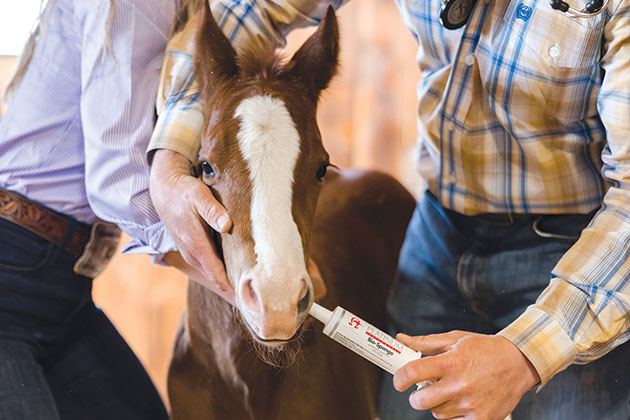
Bio-Sponge®
There When You Need It
Trusted in Barns for 20 Years
Supporting the intestinal health of the horse and foal, Bio-Sponge® has been identified as a highly-effective adsorbent that attracts and binds intestinal compounds associated with intestinal disturbances.
- Can be used prophylactically for foals on endemic farms
- Bio-Sponge® can be helpful to support foal heat scours
- Supportive for intermittent cases of diarrhea in horses and foals
Available in powder and paste
Request Platinum Magazine
Read inspiring stories of success, companionship and collaboration
At Platinum Performance, we love to showcase the success of our clients, their horses and the veterinarians that care for them. All issues of Platinum Magazine are complimentary.