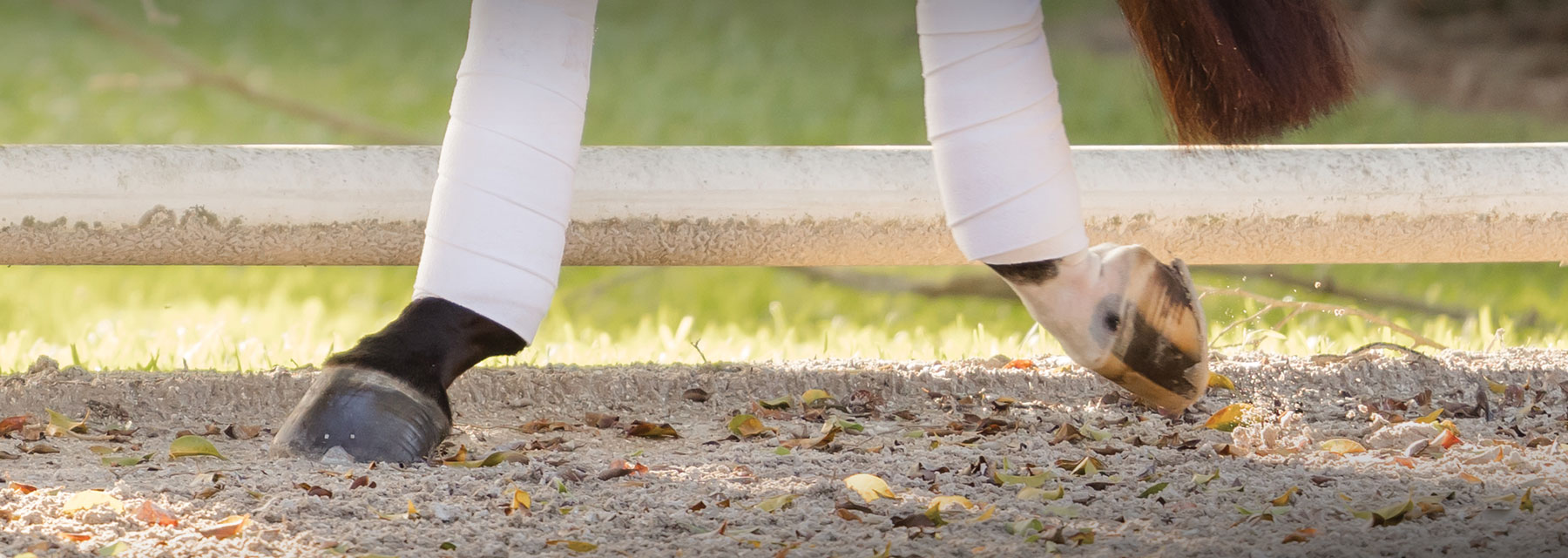
Breakover is the point in a horse’s stride at which the toe rolls and dips and the heel lifts.
PHOTOS BY ELIZABETH HAY PHOTOGRAPHY
By
Jessie Bengoa, MS
![]()
, Platinum Performance®

Jessie Bengoa, MS,
Platinum Performance®
Jessie Bengoa, MS is the author of recent articles on Equine Kissing Spines, Equine Gastric Ulcer Syndrome and Equine Herpes Virus. In addition to being a lifelong horsewoman, Jessie has over 17 years of experience in the world of food and nutrition with special expertise in equine nutrition.
A Critical Factor in Enabling Efficient Movement of The Hoof and Pivotal Support for Distal Limb Joints and Soft Tissue
The term “breakover” has evolved into a buzzword amongst horse owners, but what is it exactly, and how does it play a role in soundness and the longterm health of hooves? Breakover describes the point in a horse’s stride at which the toe rolls and dips and the heel lifts. “If you’re looking at a lateral radiograph, breakover is most commonly measured from the place where the shoe or hoof stops contacting the ground, then to the tip of P3 (also known as the coffin bone, distal phalanx or pedal bone). That distance is what we refer to as the breakover distance,” explains Matt Durham, DVM, DACVSMR, a board-certified veterinary sports medicine and rehabilitation specialist who attended farriery school prior to earning his veterinary degree and embarking on a career treating high-level sport horses for more than 20 years. “Say we have a normal barefoot horse,” he continues. “The center of weight-bearing is in the frog under the coffin joint and the center of rotation. In this well-formed foot, that position is neutral because the forces are balanced with the pull of the deep digital flexor on the back, and then the pull upward on the front of the hoof. However, if the foot is allowed to get too long, there’s an increase in torque that develops at the front of the hoof. An imbalance then occurs, increasing the load on the deep digital flexor tendon, navicular bone and heels. Generally speaking, we want a reasonably short breakover because it decreases the load on those structures.” In addition to torque, breakover also affects traction, with a disproportionally short breakover angle decreasing traction, particularly in the hinds. This can be why longer breakover can often be observed in racehorses that require as much traction as possible. It’s a delicate balance though, as Dr. Durham highlights. “A longer breakover may increase your ability to move faster, but it can also increase the load. It’s a trade-off between traction and protecting the soft tissues and navicular bone; the challenge is getting it just right.”
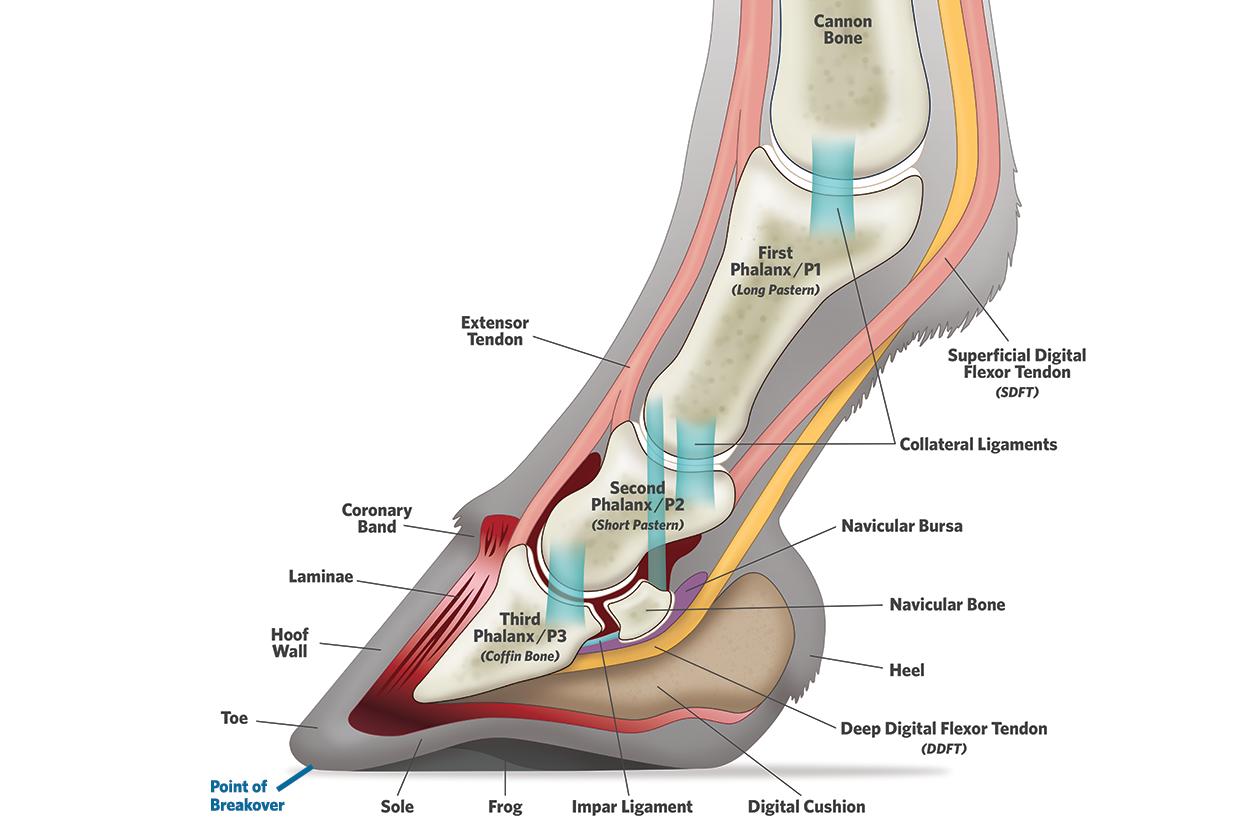
©2024 PLATINUM PERFORMANCE, INC./TOPLINE DESIGN
“Breakover is most commonly measured from the place where the shoe or hoof stops contacting the ground, then to the tip of P3 (also known as the coffin bone, distal phalanx or pedal bone). That distance is what we refer to as the breakover distance.”
— Dr. Matt Durham
Why Are Radiographs Important?
Achieving ideal breakover is an easier feat when a farrier has good podiatry radiographs to work from, giving them a look beneath the surface and more intimate knowledge of the angles at play. This is also an opportunity for veterinarians and farriers to work hand-in-hand for the benefit of the horse, with the veterinarian performing proper podiatry radiographs and the farrier then deploying their expertise to achieve the correct breakover, angle and fit. “While there are a lot of external markers that can be helpful, radiographs don’t lie. They allow everything to be right there in front of you. There’s no guessing, and you can clearly see the alignment of the bones,” says Dr. Durham. But when are these more specialized radiographs necessary and a worthwhile investment for the horse owner? “In my opinion, it’s worth doing them with a new horse to establish a good baseline,” he suggests. “There are a lot of people who feel that taking podiatry radiographs once a year is also a smart way to check in and confirm that all is well or to get a clear picture of what needs to be adjusted.” Additionally, most veterinarians and farriers will suggest regular podiatry radiographs for horses with ongoing hoof challenges, and in those cases, it can be common practice to take a set of radiographs when the horse is barefoot, then immediately following with a new set of shoes on. “This approach allows for maximum visibility into the angle to determine if it’s right,” affirms Dr. Durham. As important as breakover is, though, it’s easy to get hung up on a single factor to the detriment of other things. A functional foot has an effective breakover, an effective balance and an effective fit. All of these factors have to be balanced with each other for optimized function depending on the job of the horse, the footing it will be on and any ongoing injuries that need support or protection.
More than taking radiographs, ensuring that they’re taken by a veterinarian wellversed in podiatry-specific radiographs is crucial. “Our thinking has evolved here,” says Dr. Durham. “We now know that these are more specialized images and not your standard joint-centric radiographs.”
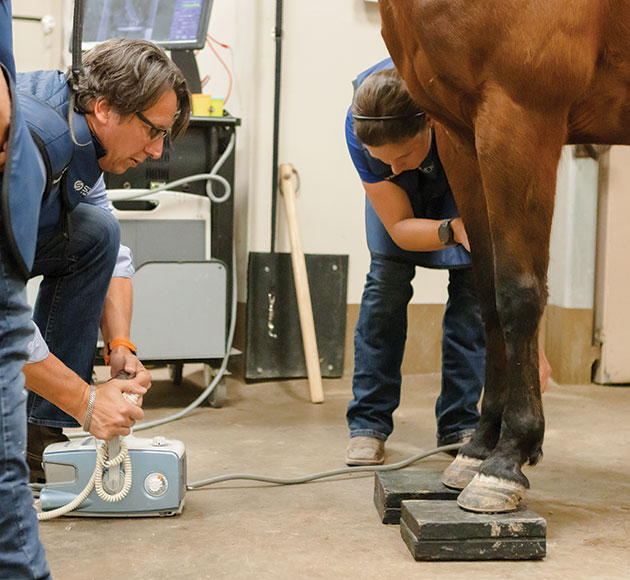
“While there are a lot of external markers that can be helpful, radiographs don’t lie. They allow everything to be right there in front of you. There’s no guessing, and you can clearly see the alignment of the bones,” says Dr. Matt Durham. Dr. Martin Vidal is seen here taking a horizontal beam dorsopalmar podiatry radiograph.
“While there are a lot of external markers that can be helpful, radiographs don’t lie. They allow everything to be right there in front of you. There’s no guessing, and you can clearly see the alignment of the bones,” says Dr. Matt Durham. Dr. Martin Vidal is seen here taking a horizontal beam dorsopalmar podiatry radiograph.
“Veterinarians and farriers can work hand-in-hand for the benefit of the horse, with the veterinarian performing proper podiatry radiographs and the farrier then deploying their expertise to achieve the correct breakover, angle and fit.
Veterinarians and farriers can work hand-in-hand for the benefit of the horse, with the veterinarian performing proper podiatry radiographs and the farrier then deploying their expertise to achieve the correct breakover, angle and fit.
“It’s worth doing them with a new horse to establish a good baseline. There are a lot of people who feel that taking podiatry radiographs once a year is also a smart way to check in and confirm that all is well or to get a clear picture of what needs to be adjusted.”
— Matt Durham, DVM, DACVSMR,
A board-certified veterinary sports medicine and rehabilitation specialist who attended farriery school prior to earning his veterinary degree
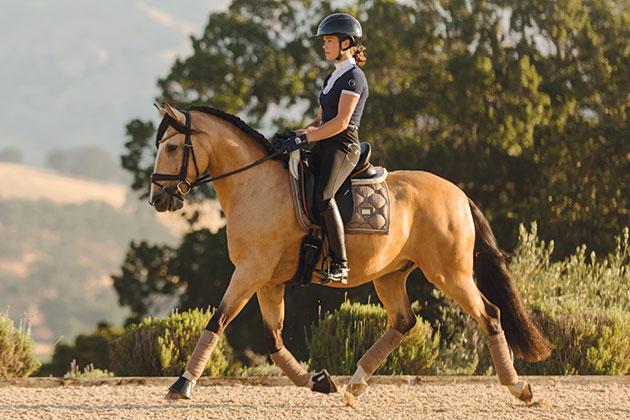
“A longer breakover may increase your ability to move faster, but it can also increase the load,” says Dr. Matt Durham. “It’s a trade-off between traction and protecting the soft tissues and navicular bone; the challenge is getting it just right.”
How Does the Center of Rotation Come into Play?
While the importance of an ideal breakover is indisputable, there are closely related factors that matter just as much in the horse’s long-term soundness and optimal hoof health. “Everybody talks about breakover, and it’s important no question, but there’s more to it,” says Lee Olsen, Certified Journeyman Farrier (CJF) and owner of Olsen Equine, a well-respected haul-in farriery practice in Weatherford, Texas. “I'm a huge proponent of shoeing around the center of rotation for horses that are rehabbing a hoof or orthopedic injury; it’s imperative for success. The coffin joint (P3) is a hinge joint; it's going to hinge back and forth. If you've got more (length) out in front, and less at the back, it's kind of like a human trying to be athletic with a clown shoe on.” To Olsen, mistakes can happen when farriers become too focused on shoeing to the radiographs. “Keep in mind that radiographs, while an excellent tool, are only a two-dimensional image of a three-dimensional structure. In the past I had a particular case that was a good representation of this. I was personally weakening the hoof wall by setting the shoe back in an attempt to make the radiographs perfect to the center of rotation. As I learned and improved my own skills, I started using a salad bowl shoe and a rocker toe in a flat shoe. Where historically I had gotten sore heels or sole on this horse without pads, I now didn’t have issues with maintaining soundness. I also added in nutritional support with Platinum Performance ® DJ and Platinum Hoof Support. Coupled with a better shoeing application, I’ve seen a lot more success and a lot better growth, all by focusing on fitting the entire hoof and being proactive with the leverage at the toe.”
“I’ve seen a lot more success and a lot better growth, all by focusing on fitting the entire hoof and being proactive with the leverage at the toe.”
— Lee Olsen, CJF, Olsen Equine
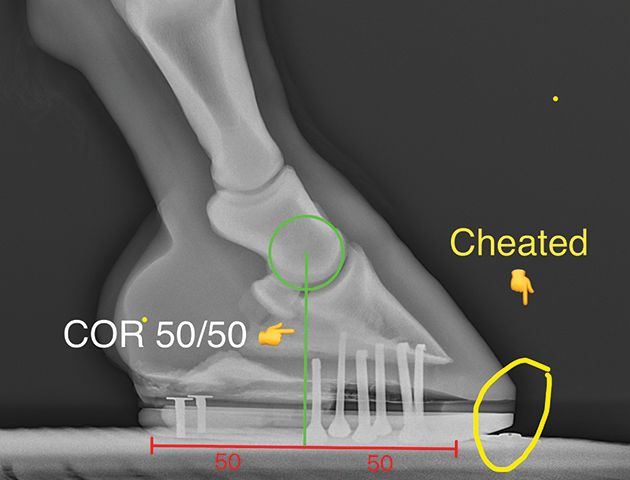
“It is often common practice to set the shoe back off the toe like you see in this radiograph with a ‘cheated’ toe. Here, I was attempting to make the radiographs perfect to the Center of Rotation (COR) 50/50, but in doing so, I was weakening the hoof wall.”
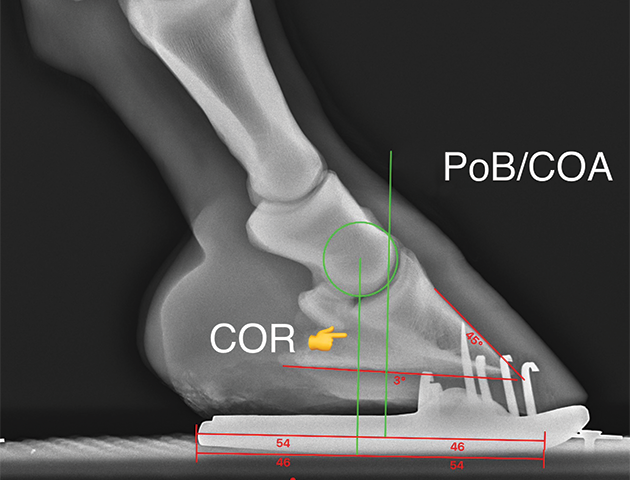
“This is the same horse as in Image 1, but three years later. In that time, I focused on making the back half of the hoof stronger with pads, and I began using both a salad bowl shoe and a rocker toe in a flat shoe.”
What About Angle?
While breakover is about achieving balance, it equally includes the nuances of angle. “We like to think of all the joints in a horse being aligned with the midline of the horse, so that everything flexes along those planes,” says Dr. Durham. “It turns out, that’s not actually the case. For example, the fetlock and the coffin joint are not parallel joints. The fetlock is angled out to the point where when the horse brings its limbs up; it’s not a perfectly straight flexion, but rather it’s an outward movement.” What does that mean for breakover? “That breakover is not perfectly aligned with that straight line; it’s a little more off center,” continues Dr. Durham. “That can be a little confusing when you’re not seasoned in what you’re looking for. But if you ever pick up a horse’s foot, you’ll see that the wear line doesn’t necessarily align symmetrically with the frog. It would be simpler to think that the midpoint of breakover should be at the midline of the toe, but that’s not necessarily where it is. The flexion isn’t just coming from the coffin joint; it’s coming from the flexion of the whole limb, and the majority of flexion regarding breakover actually comes from the fetlock,” he says. Concurrently, horses that perform a high amount of lateral work — Western performance or polo horses, for example — also require lateral breakover to be considered. “That doesn't necessarily come directly from the side. It’s more of a consideration from the front corners,” explains Dr. Durham. “Imagine a horse that’s continually turning at speed. They’re coming over the two o’clock position at the corners. A lot of shoes that enhance breakover are very square, and while that’s a good thing for some cases because it allows for forward motion to work well, those hard corners can end up being a problem in horses with a lot of lateral movement. They’ll have an almost exaggerated breakover in those shoes during diagonal movements, and that can potentially overload some of those structures that stabilize the limb laterally, like the collateral ligaments.”
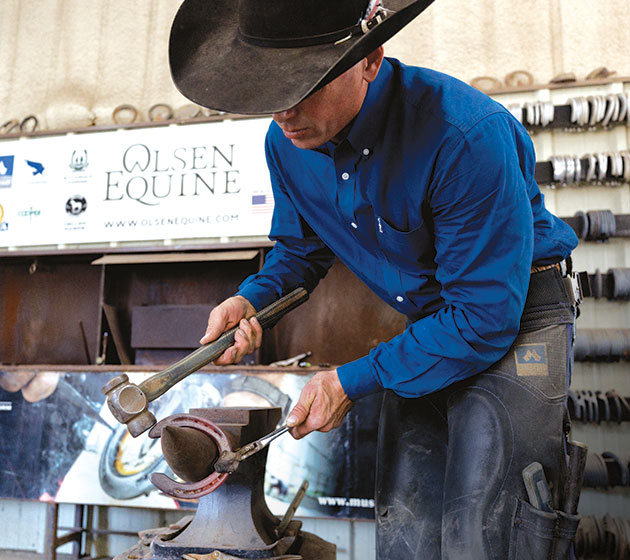
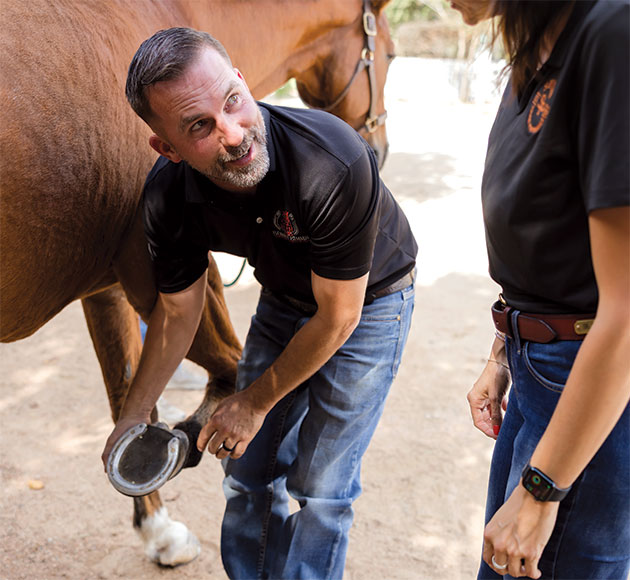
There is an array of factors that a farrier considers with each shoeing, with breakover being of central importance, along with shoeing for balance, selecting the proper shoe, examining hoof quality, therapeutic farriery services and considering diet and nutrient deficiencies. Lee Olsen, CJF, is working on a shoe.
There is an array of factors that a farrier considers with each shoeing, with breakover being of central importance, along with shoeing for balance, selecting the proper shoe, examining hoof quality, therapeutic farriery services and considering diet and nutrient deficiencies. Lee Olsen, CJF, is working on a shoe.
What Should I Keep in Mind?
As horse owners, it’s important to have a two-way dialogue with your farrier and to ensure that your veterinarian and farrier are willing to constructively work together for breakover and the numerous other preventive measures that can be taken to maintain your horse. Perhaps even more important is what each of those experts brings to the table when something goes wrong, when there’s a lameness or hoof condition that presents or when there’s something that just doesn’t feel right. Where breakover is concerned, a veterinarian’s contribution with podiatry radiographs can be extremely beneficial for your farrier, surfacing vital information. As your farrier works to achieve an optimal breakover angle, they’re also considering other important factors as well, including shoe choice — rocked or rolled shoes, for instance — and the ideal shoeing schedule for your horse. If a horse happens to go longer than the 6-8 weeks recommended and stretches out to 10- 12 weeks from one shoeing to the next, breakover can fluctuate significantly in that time period as the hoof grows. “The breakover at the start is much shorter than the break over at the end,” confirms Dr. Durham. “The horse adapts to a longer breakover through that time period, then, all of a sudden, it’s short again. The effect on tendons and ligaments can’t be ignored, and that’s one of the reasons we recommend more frequent visits. The goal is not to keep getting shorter and shorter, but rather, to maintain a consistent breakover.”
There is an array of factors that a farrier considers with each shoeing, with breakover being of central importance, along with shoeing for balance, selecting the proper shoe for case specifics, examining hoof quality, providing therapeutic farriery services when issues arise and considering diet and nutrient deficiencies that can impact the hoof. All-in-all, farriers are an indispensable part of a horse’s care team and can provide a wealth of knowledge about the foundation upon which our horses stand, the hooves.
Request Platinum Magazine
Read inspiring stories of success, companionship and collaboration
At Platinum Performance, we love to showcase the success of our clients, their horses and the veterinarians that care for them. All issues of Platinum Magazine are complimentary.